The five principles, responsibilities and freedoms, the test
Reading
about 12 min
Quizzes
10 questions
British Values and Principles
On 26 February 2004, in the town hall of Brent in north-west London, 19 people from all over the world stood up and made a promise. With that, they became British citizens. Watching them was the Prince of Wales. It was the first citizenship ceremony ever held in the UK.
Ever since, every new citizen has said a short pledge at their ceremony. They promise to keep Britain's laws and to protect its democratic values. That pledge is what this chapter is about. What does British society care about most? If you want to make your home in the UK for good, what do you have to do, and what freedoms do you get? At the end, we also look at how the Life in the UK test itself works.
This chapter is very short, but don't skip it: test questions come from the whole handbook, and that includes this chapter.
Why take the Life in the UK test?
Asking to become a permanent resident (permanent residence means you can stay in the UK with no time limit) or a British citizen is a big step. It is also a promise. When you apply, you are agreeing to take on a permanent resident's responsibilities and to respect the UK's laws, values and traditions. Passing the Life in the UK test is one way to show that you are ready for life here in the long term.
The handbook itself has a clear aim: to help you settle into society, play a full part in your local community, and learn the basics of British culture, law and history.
What you need
Whether you want permanent residence or want to become a British citizen by naturalisation (the way someone who was not born British applies for citizenship), you have to meet two conditions. You must be able to speak and read English, and you must have a good understanding of life in the UK.
In practice, this means doing two things. It is not a choice between them: you need both.
1. Pass the Life in the UK test
This is the test this site helps you prepare for.
2. Prove your English at B1
You must give acceptable evidence that your English speaking and listening reach level B1 of the Common European Framework of Reference (CEFR), an international scale of language levels. B1 is the same as ESOL Entry Level 3.
ESOL stands for English for Speakers of Other Languages. These are English classes for people whose first language is not English, and Entry Level 3 is one of the levels.
How do you prove your English? One way is a pass in a recognised English test, taken at an approved test centre. For all the details, see the website of the Home Office, the government department in charge of immigration.
The requirements may change. Before you apply for settlement (another word for permanent residence) or for citizenship, check the Home Office website for the rules that apply at that moment.
Quiz
Which of the following statements is correct?
You need both: a Life in the UK test pass, and evidence of English speaking and listening at B1. It is not a choice between the two.
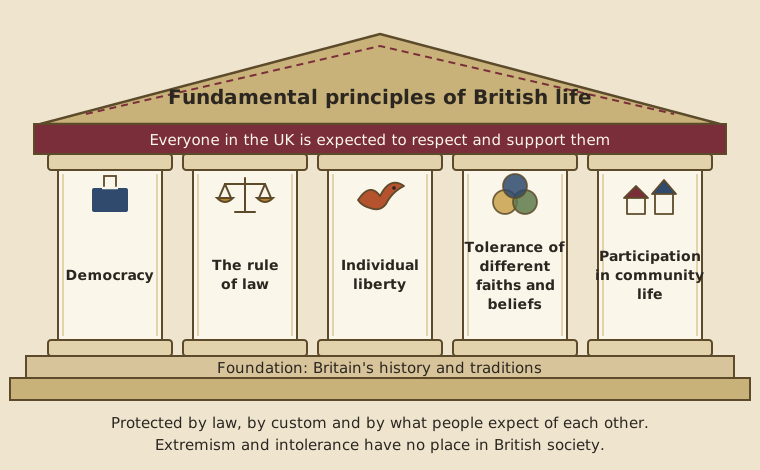
Five pillars: the fundamental principles of British life
British society rests on a set of fundamental values and principles. Everyone who lives here, citizen or not, is expected to respect and support them. They grew out of the country's history and traditions. They are kept safe by the law, by custom and by what people expect of each other. And you can see them in the rights, privileges and responsibilities that citizens and permanent residents have.
One thing is very clear: extremism (holding extreme views, often with violence) and intolerance (refusing to accept people who are different from you) have no place in British society.
Think of the five principles as five pillars holding up a roof. Take any one away and the roof starts to lean.
Here are the five pillars:
Democracy: the people choose who runs the country.
The rule of law: everyone has to obey the law, including people with power.
Individual liberty: within the law, you decide how to live your own life.
Tolerance of those with different faiths and beliefs: accepting people whose religion or beliefs are not the same as yours.
Participation in community life: taking part in the life of the place where you live.
The rule of law has the oldest roots of the five. In England, the idea that even the king must obey the law goes back to 1215, when a group of powerful barons forced King John to accept Magna Carta. For the first time, someone wrote down that the king's power had limits. You can read the full story in the History chapter The Middle Ages.
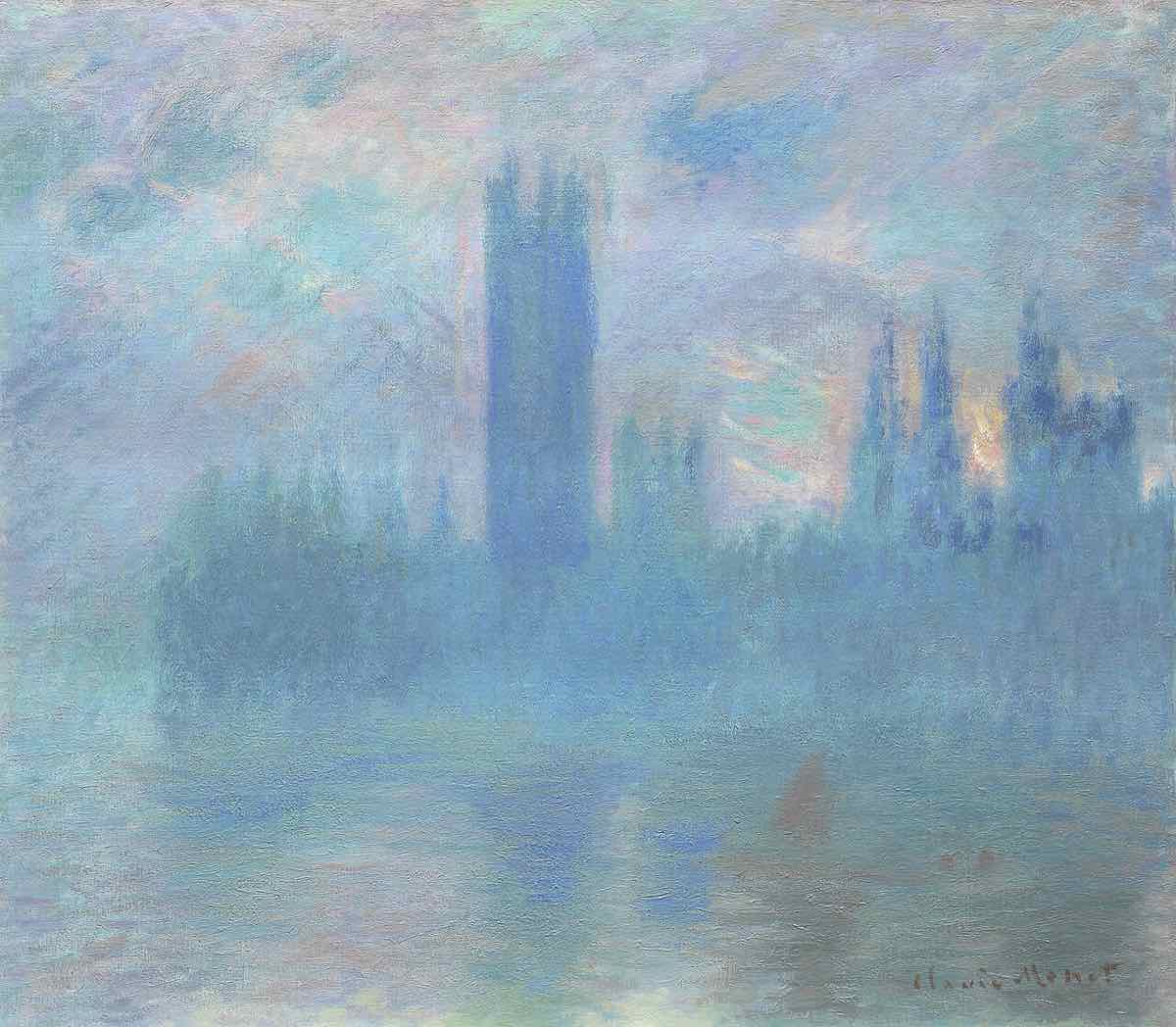
The Houses of Parliament in London, painted by the French artist Claude Monet between 1900 and 1903. This building is where British democracy does its work. The topic "The UK government, the law and your role" explains it in detail.
Claude Monet, Art Institute of Chicago, CC0, via Wikimedia Commons
Quiz
Which of the following is one of the fundamental principles of British life?
The five principles are democracy, the rule of law, individual liberty, tolerance of people with different faiths and beliefs, and participation in community life. The UK has many political parties, and religion is a personal freedom: nobody is made to go to a place of worship. There is no compulsory military service either.
The citizenship pledge: a promise said out loud
At the citizenship ceremony we met at the start of this chapter, new citizens promise to protect these values. This promise is called the pledge. In our own words, it says:
New citizens promise to be loyal to the United Kingdom and to respect its rights and freedoms. They promise to defend its democratic values, to keep its laws faithfully, and to carry out everything that is expected of them as British citizens.
Broken down, that makes four promises:
Be loyal to the UK
Respect rights and freedoms
Uphold democratic values
Obey the law and do your duty as a citizen
According to GOV.UK, the ceremony has two parts. First you swear an oath of allegiance, a promise to be loyal to the monarch; if you would rather not swear by God, you can make an affirmation instead, which has no religious words. Then you say the pledge. Ceremonies are arranged by the local council: if you are 18 or over you must attend one within 3 months of your Home Office invitation, and at the end you receive your certificate of British citizenship.
Quiz
At a citizenship ceremony, what do new citizens promise in the pledge?
The pledge is about loyalty to the UK, respecting its rights and freedoms, upholding its democratic values, and obeying the law and doing your duty as a citizen. Voting is not compulsory in the UK, and the pledge says nothing about joining the army or staying in the UK for the rest of your life.
Responsibilities and freedoms: a two-way deal
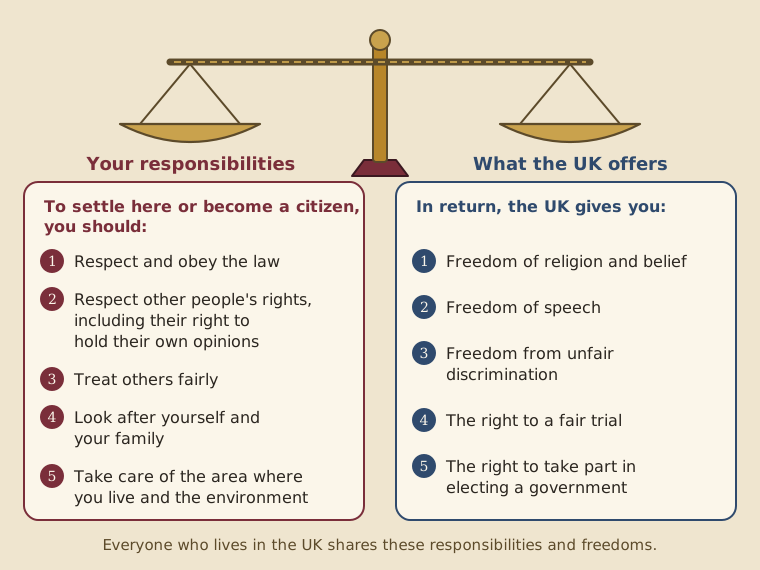
These principles lead to a set of responsibilities and freedoms that are shared by everyone who lives in the UK. Whether you are a citizen or not, you are expected to respect them. There are two lists. One says what you should do if you want to become a permanent resident or citizen. The other says what the UK gives you in return.
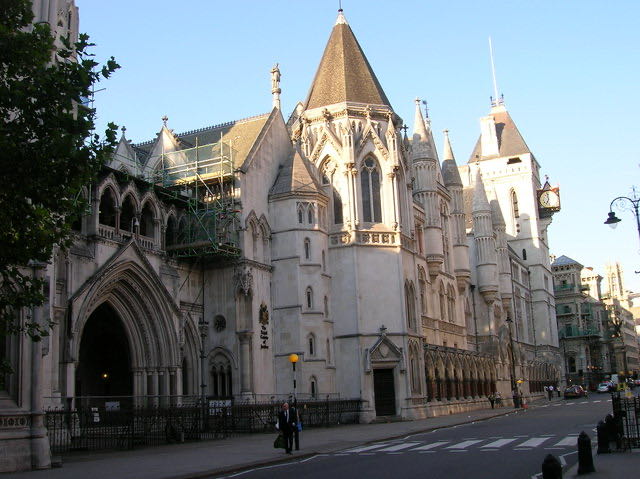
Five on each side, so you can learn them as a pair. You obey the law, respect other people, treat people fairly, and look after your family and your surroundings. In return, the UK protects your beliefs, your free speech, fair treatment, a fair trial and your vote.The Royal Courts of Justice on the Strand in London. The High Court and the Court of Appeal of England and Wales sit here. The right to a fair trial is one of the protections the UK gives to every resident.
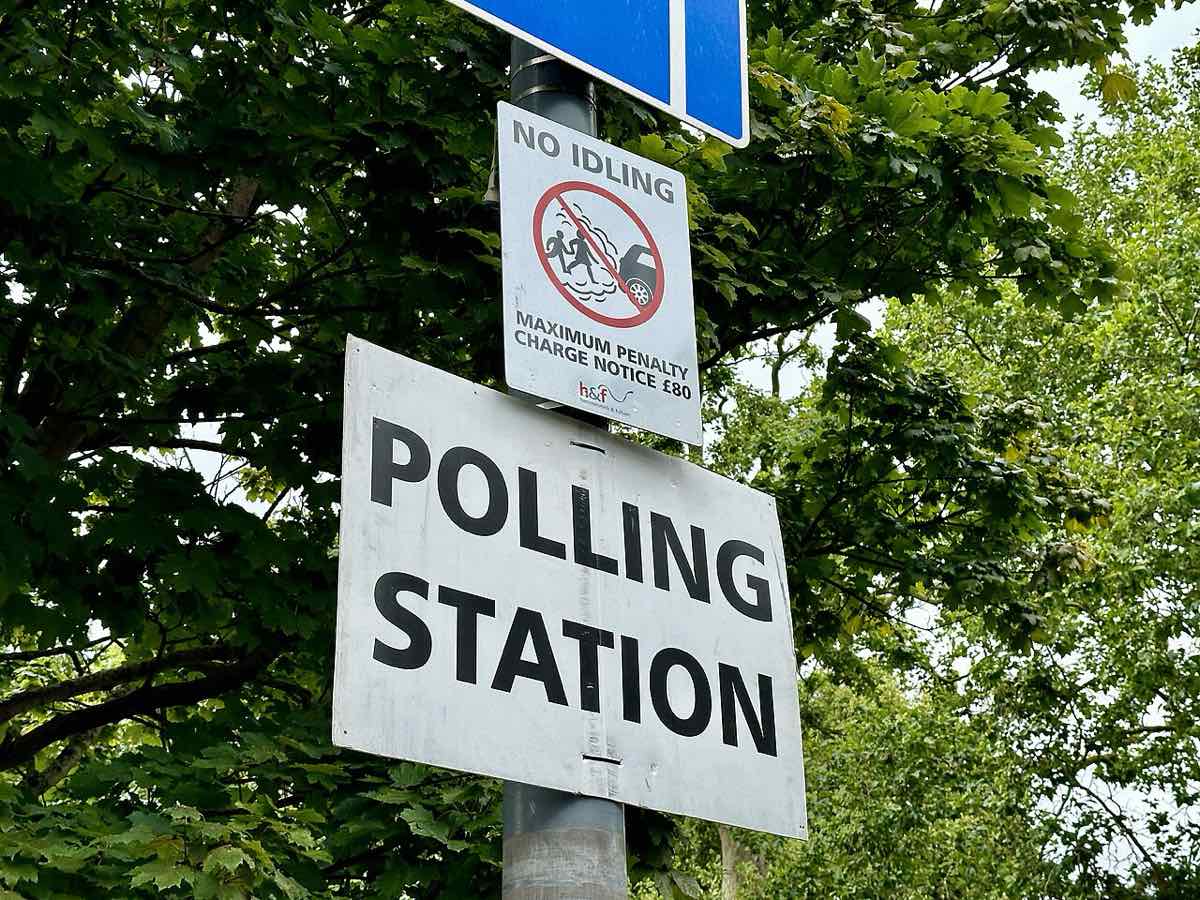
Photo: R Sones / Geograph, CC BY-SA 2.0, via Wikimedia CommonsA polling station sign on election day. This is where your right to help choose the government becomes real.
Photo: Matt Brown, CC BY 2.0, via Wikimedia CommonsThe Reformers' Tree mosaic in Hyde Park. In the 19th century, people campaigning for the right to vote often met under this tree. That helped make Hyde Park a place for free speech, and Speakers' Corner is in the same park. At Speakers' Corner, according to The Royal Parks, a law of 1872 set out the right to meet and speak freely in the park. Anyone can still turn up without permission and speak on any subject, as long as what they say is legal, and the police decide that. Between 1906 and 1914 the suffragettes often held rallies here too.
Photo: August Schwerdfeger, CC BY 4.0, via Wikimedia Commons
Quiz
Which TWO of these are freedoms or rights that the UK offers to its residents?
The UK offers five things: freedom of religion and belief, freedom of speech, freedom from unfair discrimination, the right to a fair trial, and the right to take part in electing a government. Free housing and not paying income tax are not on the list.
Quiz
Which of the following statements is correct?
Taking care of the area where you live and the environment is one of the five responsibilities. A is wrong: you are expected to respect other people's rights, including their right to have their own opinions, whether they agree with you or not.
Quiz
Which TWO of these are responsibilities expected of anyone who wants to live in the UK permanently or become a citizen?
The five responsibilities are: obey the law, respect other people's rights, treat others fairly, look after yourself and your family, and look after your area and the environment. B is wrong because worship is your own choice: freedom of belief and religion is one of the things the UK offers you. C is wrong because taking part in electing a government is listed as a right you have, not a duty.
How the Life in the UK test works
To finish, here are the practical facts about the test itself.
24 questions
From the whole book
Approved test centres only
Book online only
Questions: there are 24, about important parts of life in the UK. They can come from any part of the handbook. Good news: you don't need to learn anyone's dates of birth or death. Everyone sitting the test in the same session gets a different set of 24.
Language: the test is normally in English. If you would like to take it in Welsh or Scottish Gaelic, this can be specially arranged.
Where: only at a Life in the UK test centre that is registered and approved. There are over 30 of them in the UK. Don't sit the test anywhere else, because the Home Office only accepts certificates from registered centres. If you live in the Channel Islands or on the Isle of Man, the arrangements are different. You'll find out what these places are in the next chapter.
Booking: you can only book online, on the government's Life in the UK test page (gov.uk/life-in-the-uk-test). When you book, read the instructions with care and make sure your personal details are right.
On the day: bring proof of identity and proof of your address. If you forget them, you can't take the test.
Being able to take the test in Welsh or Scottish Gaelic sounds thoughtful, but hardly anyone does it. Figures released after a member of the public asked the government for them showed only one test on record in each language up to 2020. In January 2020 a Brazilian man living in Cardiff, the capital of Wales, passed the test in Welsh. He was reported to be the first person ever to pass the Welsh version, and his story was later shown on Brazilian television.
As for the handbook itself: if your English is at ESOL Entry Level 3 or higher, you should be able to read it without trouble. At the back there is a glossary, a list of important words and phrases with their meanings. Each chapter ends with a "Check that you understand" box, but these boxes are only a guide. Learning what's in them is not enough: you need to understand the whole book.
For more information, there are three places to look: the Home Office website for how to apply and which forms to use; the Life in the UK test website for the test and booking; and the government website (Gov.uk) for ESOL courses and where to find one near you.
Quiz
Is the statement below TRUE or FALSE?
The Life in the UK test can only ever be taken in English.
False. The test is usually in English, but you can ask to take it in Welsh or Scottish Gaelic, and special arrangements will be made.
Quiz
How many questions are there in the Life in the UK test?
There are 24 questions, and they can come from any part of the handbook.
Quiz
According to the handbook, where must you take the Life in the UK test so that your certificate is accepted?
Only registered and approved test centres count; certificates from anywhere else are not accepted. You book online, but you can't take the test at home.
Quiz
According to the handbook, how many Life in the UK test centres are there in the UK?
There are over 30 test centres in the UK.
Chapter summary
Five principles
Democracy, the rule of law, individual liberty, tolerance of people with different faiths and beliefs, participation in community life
No extremism
The values are rooted in history and traditions; law, customs and expectations protect them; extremism and intolerance have no place in British society
Citizenship pledge
Loyalty to the UK, respect for its rights and freedoms, upholding democratic values, obeying the law and doing your duties as a citizen
Responsibilities
Obey the law; respect others' rights and opinions; treat others fairly; look after yourself and your family; look after your area and the environment
Freedoms
Freedom of religion and belief, freedom of speech, freedom from unfair discrimination, a fair trial, a part in electing the government
Requirements
For permanent residence or naturalisation: speak and read English and understand life in the UK, so pass the Life in the UK test and show B1 English speaking and listening (equal to ESOL Entry Level 3)
Proving English
For example a pass in a recognised English test at an approved test centre; details and current rules on the Home Office website
The test
24 questions from the whole book, different for each person; no need to remember dates of birth or death; usually in English, with Welsh or Scottish Gaelic possible
Test centres
Registered and approved centres only (over 30); book online only, on GOV.UK; bring proof of identity and address; different arrangements for the Isle of Man and the Channel Islands

 Be loyal to the UK
 Respect rights and freedoms
 Uphold democratic values
 Obey the law and do your duty as a citizen

 24 questions
 From the whole book
 Approved test centres only
 Book online only