Today, to get from London to Paris you take a boat, a plane, or a train through a tunnel under the sea. But if you had lived more than 10,000 years ago, you could simply have walked east until you reached mainland Europe, without even getting your feet wet.
This chapter starts in that time, when you could walk to Britain, and ends when the Roman army left in AD 410. Along the way you'll meet a village built of stone, a cape made of gold, forts on hilltops, and a queen who set London on fire.
Stone AgeHunter-gatherers come and go across a land bridge
8000 BCAbout 10,000 years ago: the sea cuts Britain off from mainland Europe for good
4000 BCAbout 6,000 years ago: the first farmers arrive in Britain
2000 BCAbout 4,000 years ago: the Bronze Age begins as people learn to make bronze
Iron AgeIron tools, hill forts and Britain's first coins
55 BCJulius Caesar invades, without success
AD 43Emperor Claudius leads an invasion, and the Romans take over most of Britain
AD 122Work begins on Hadrian's Wall
AD 410The Roman army leaves Britain and never comes back
The Stone Age: walking to Britain
Britain's earliest people were hunter-gatherers. They did not farm. Instead they lived by hunting animals and collecting wild food such as fruit.
For most of the Stone Age, a land bridge joined Britain to mainland Europe. People moved back and forth across it, following the deer and horses they hunted. Around 10,000 years ago the sea rose and covered the land bridge, and Britain became an island.
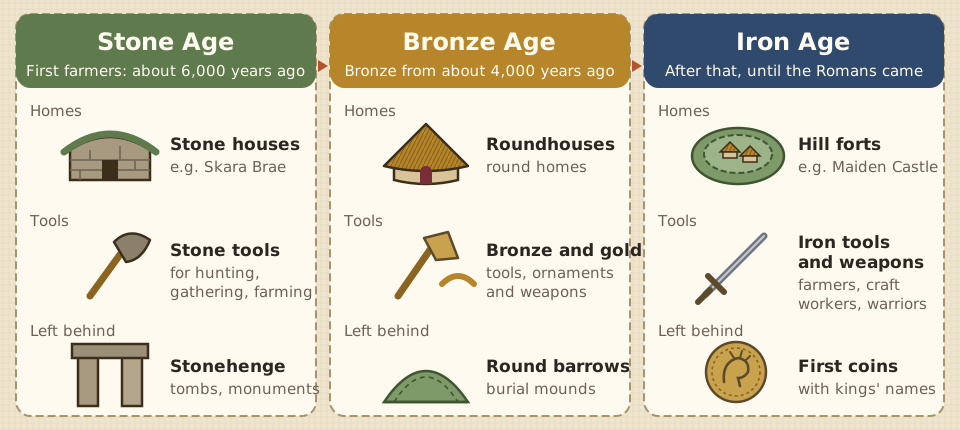
About 6,000 years ago, the first farmers arrived. Their ancestors probably came from south-east Europe. Farmers built houses, tombs and monuments, and some of these can still be seen today.
Quiz
Is the statement below TRUE or FALSE?
The Channel cut Britain off from mainland Europe for good only around 1,000 years ago.
False. It was about 10,000 years ago. A thousand years ago was already the time of the Vikings and the Normans. To remember the order: first Britain was cut off (10,000 years ago), then farming arrived (6,000 years ago).
Quiz
Who were the first people to live in Britain, during the Stone Age?
Britain's first people were hunter-gatherers, who lived by hunting animals and collecting wild food. Farmers came much later, about 6,000 years ago, so A is wrong. The Romans and the Anglo-Saxons arrived thousands of years after that.
Quiz
Which TWO statements about Britain's first farmers are correct?
The first farmers came about 6,000 years ago, and their ancestors probably came from south-east Europe. B is wrong: hunter-gatherers had lived in Britain long before them. D is wrong because the Romans did not invade until thousands of years later.
Stonehenge: a prehistoric meeting place
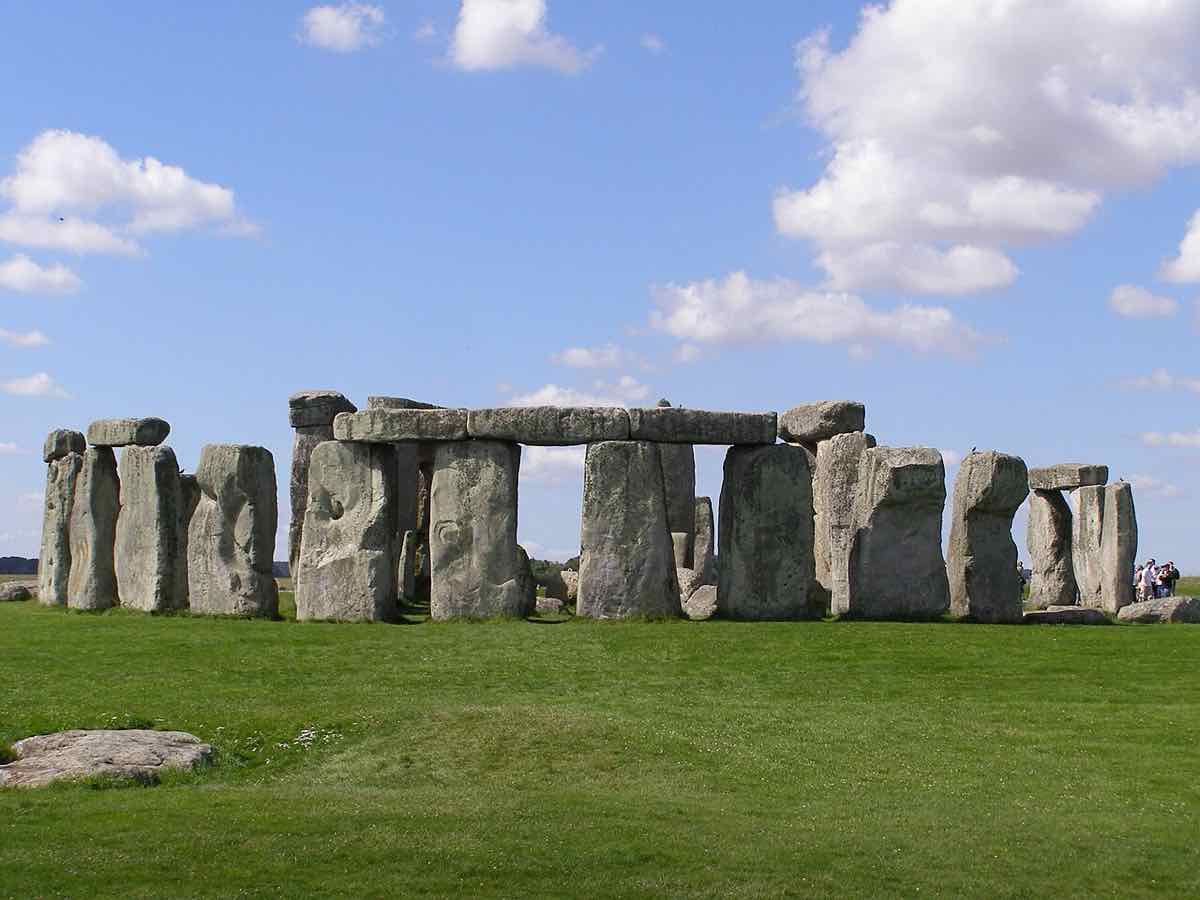
On a plain in Wiltshire, in England, stands a ring of huge upright stones: Stonehenge. It is the most famous monument left from the Stone Age. Nobody knows for certain what it was for, but people probably gathered there for ceremonies at certain times of the year. Today it is a UNESCO World Heritage Site.
Stonehenge. A pair of upright stones with a third laid across the top is called a trilithon.
Photo: garethwiscombe, CC BY 2.0, via Wikimedia Commons
Whoever built it planned it carefully: the stones line up with the sunrise at midsummer and the sunset at midwinter. They also hauled them a long way. The big sarsens came from about 25 km away, the smaller "bluestones" from the Preseli Hills in Wales, about 240 km away, and in 2024 a study in the journal Nature traced the "Altar Stone" in the middle to north-east Scotland, some 700 km away. Exactly how stones weighing several tonnes were moved that far is still being worked out.
Skara Brae: a village uncovered by a storm
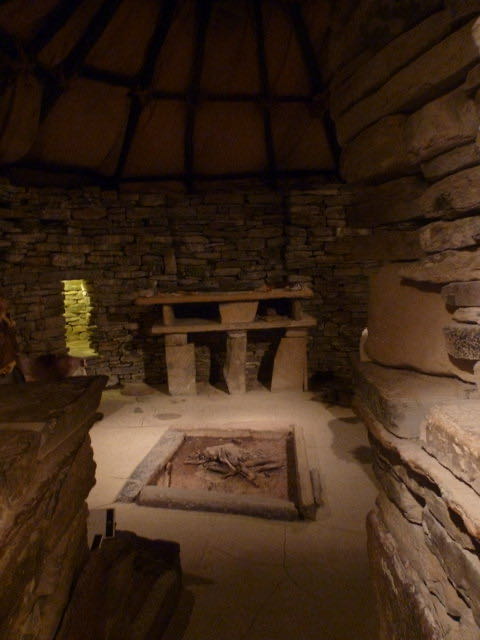
On Orkney, a group of islands off the north coast of Scotland, there is a Stone Age village called Skara Brae. No prehistoric village in northern Europe is better preserved, and it has taught archaeologists a great deal about how people lived at the end of the Stone Age.
People lived there from about 3180 BC to 2500 BC, until drifting sand dunes covered it. It stayed hidden for more than 4,000 years. Then, in the winter of 1850, a great storm stripped the sand from the shore, and local people found the roofless stone houses underneath.
A house at Skara Brae. The fireplace is in the middle, the stone shelves at the back work like a dresser, and the stone boxes on each side are beds. Wood was scarce on Orkney, so even the furniture is stone, and several houses share almost the same layout: a 5,000-year-old "standard floor plan".
Photo: Chris Downer / Geograph, CC BY-SA 2.0, via Wikimedia Commons
Quiz
Which TWO of the following are Stone Age sites that can still be seen today?
Stonehenge and Skara Brae are both Stone Age sites. Hadrian's Wall was built by the Romans, and the Tower of London was built by William I after 1066.
Quiz
Where would you go to see Skara Brae, a Stone Age village better preserved than any other prehistoric village in northern Europe?
Skara Brae is on Orkney, north of mainland Scotland. Wiltshire is where you'll find Stonehenge, and Dorset is home to Maiden Castle, which comes up shortly. The test often mixes up these three places.
The Bronze Age: skilled metalworkers
About 4,000 years ago, people learned to melt copper and tin together to make a harder metal, bronze. This was the start of the Bronze Age.
People lived in roundhouses, and when they died they were buried in earth mounds called round barrows. If you walk in the British countryside today, you will often still see these small hills, shaped like an upside-down bowl.
Bronze Age people were very skilled metalworkers. They made many beautiful tools, ornaments and weapons from bronze and gold.
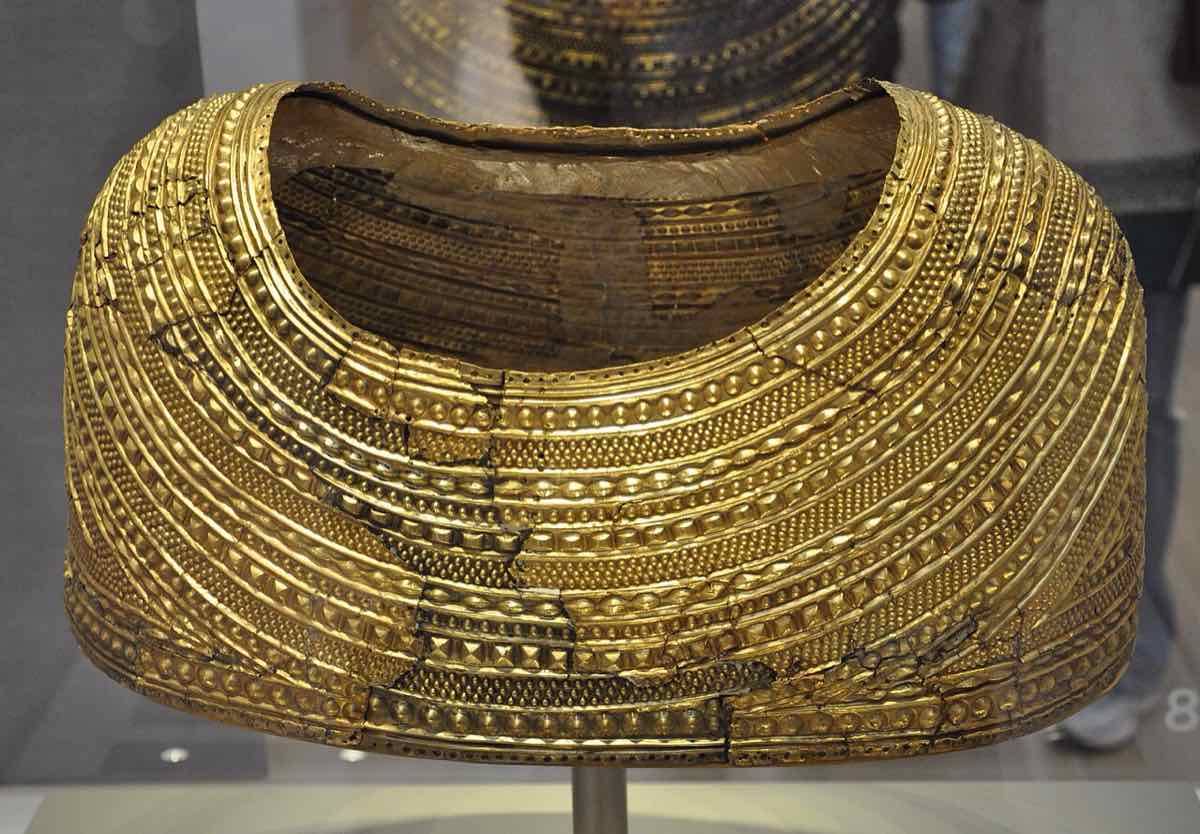
The Mold gold cape, from about 1900–1600 BC, now in the British Museum. The whole cape was hammered out of a single piece of gold. Workmen found it in 1833 in a Bronze Age burial mound near Mold in Wales, still around the shoulders of the person buried there. Local people had always called the mound Bryn yr Ellyllon, "the goblins' hill".
Photo: Andreas Praefcke, public domain, via Wikimedia Commons
Quiz
In the Bronze Age, what were the tombs in which people buried their dead called?
Round barrows were Bronze Age tombs. Hill forts were defended sites in the Iron Age, cathedrals belong to the Middle Ages, and villas to Roman times.
The Iron Age: forts on the hilltops
Next, people learned to make tools and weapons from iron. This was the Iron Age. People still lived in roundhouses, but now these were grouped into bigger settlements, sometimes on hilltops protected by banks and ditches. These are called hill forts.
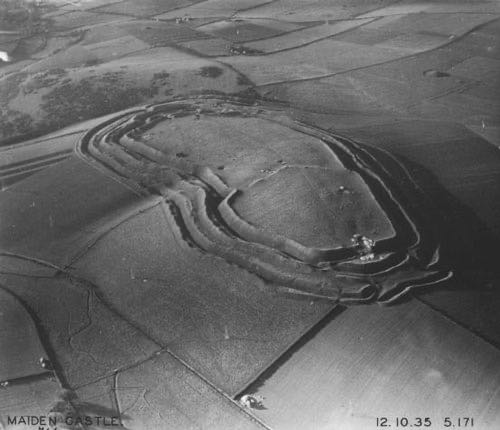
One very impressive hill fort, Maiden Castle in Dorset, England, can still be visited today. Despite its name, it isn't a medieval stone castle. It is made of rings of earth banks and ditches, one inside another.
The three ages at a glance. Each one is named after its material: stone, then bronze, then iron, each harder than the one before.Maiden Castle from the air in 1935. The hilltop is surrounded by several rings of banks and ditches. After it was enlarged around 450 BC it covered about 19 hectares, roughly 27 football pitches, which makes it the largest hill fort in Britain.
Photo: Major George Allen (1891–1940), Ashmolean Museum, Oxford, public domain, via Wikimedia Commons
Most people in the Iron Age were farmers, craft workers or warriors. Their language belonged to the Celtic family of languages. Similar languages were spoken all over Europe at the time. Related languages, such as Welsh and Gaelic, are still spoken in parts of Wales, Scotland and Ireland today.
By now, people had quite an advanced society and economy. Iron Age people made the first coins ever minted in Britain (minted means made by stamping metal), and some of them carry the names of Iron Age kings. Once names were written down, we could know who some of these people were for the first time. That is why this is where British history begins.
One name turns up again and again on these coins: Cunobelinus, who ruled the land just north of today's London and had coins struck at Colchester and St Albans. He was remembered for a long time. About 1,600 years later, Shakespeare made him the hero of his play Cymbeline.
Quiz
What is Maiden Castle in Dorset?
Maiden Castle is an Iron Age hill fort. It has "castle" in its name, but it is not a Norman castle. The Stone Age village is Skara Brae, and the forts on Hadrian's Wall include Housesteads and Vindolanda.
Quiz
Which of the following statements is correct?
Britain's first home-made coins appeared in the Iron Age, before the Romans came and long before the Normans.
The Romans arrive
Even before Cunobelinus's time, a much bigger power had reached the far side of the Channel: in the 50s BC the armies of Rome were conquering Gaul, roughly today's France. In 55 BC the Roman general Julius Caesar crossed the sea and invaded Britain, but his invasion failed. For almost a hundred years after that, Rome did not rule Britain.
In AD 43 the Roman Emperor Claudius led a new invasion. This time the Romans succeeded, and they took control of almost all of Britain.
Quiz
Which of the following statements is correct?
Caesar's invasion failed. Rome only took over Britain after Claudius invaded in AD 43.
Quiz
Who led the Roman army in the invasion of AD 43, after which the Romans occupied almost all of Britain?
A way to remember the order: Caesar came first (55 BC, failed), Claudius came next (AD 43, succeeded), then Hadrian built the wall (from AD 122). William the Conqueror belongs to 1066.
Boudicca: the queen who burned London
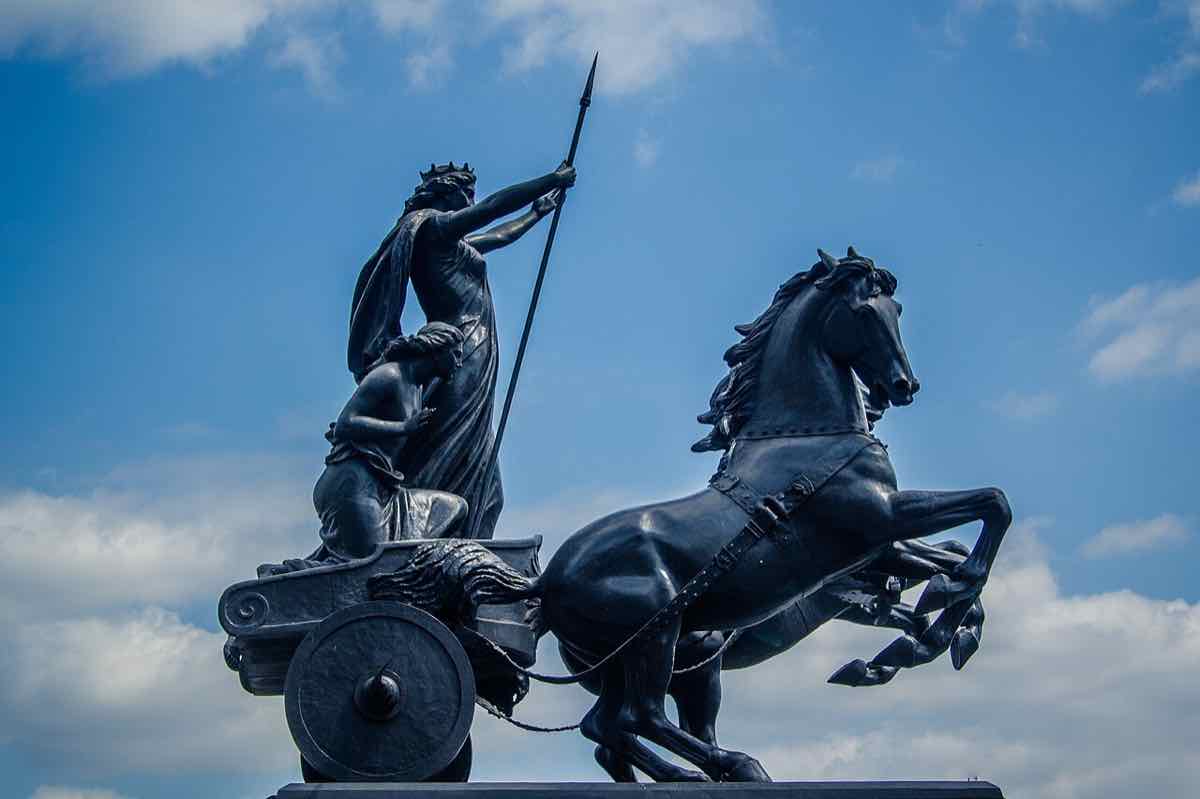
When the Romans invaded, some tribes fought back. The most famous of their leaders was Boudicca, queen of the Iceni, a tribe from the east of what is now England. People in Britain still remember her: in London, there is a statue of her beside Westminster Bridge, close to the Houses of Parliament.
In AD 60 or 61 she led the Iceni and other tribes in a great revolt. They burned three Roman towns: Colchester, St Albans and London (Londinium), which the Romans had founded only 10 to 15 years before. In the end the Roman governor's army defeated her.
The statue Boadicea and Her Daughters beside Westminster Bridge, facing the Houses of Parliament and Big Ben. The Victorian sculptor Thomas Thornycroft made it, and it has stood here since 1902. The blades on the wheels look dramatic, but historians think the idea came from Roman chariots, not from anything the Iceni used.
Photo: DigitalFuture123, CC BY-SA 3.0, via Wikimedia Commons
Quiz
Which TWO statements about Boudicca are correct?
Boudicca was the queen of the Iceni who fought against the Romans; she was not Roman herself. It was the Roman emperor Hadrian who built a wall to keep out the Picts.
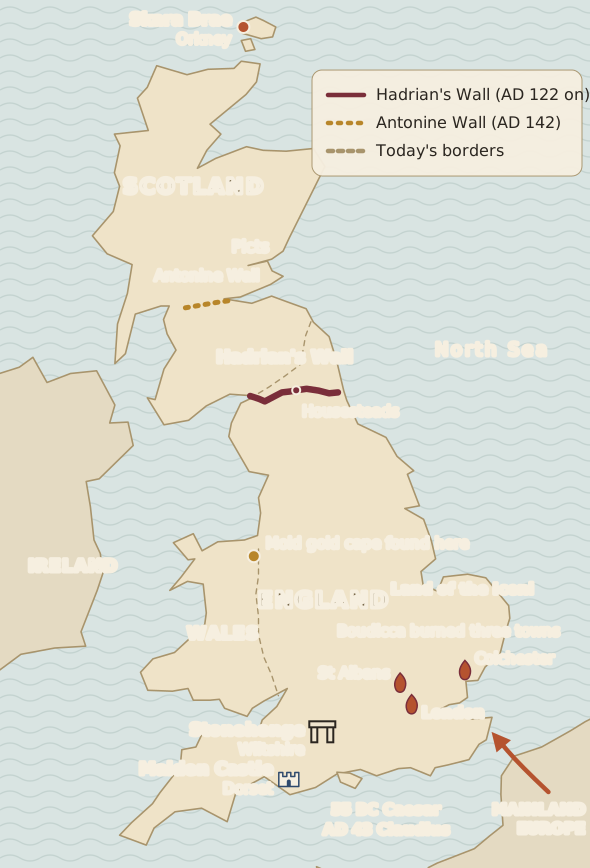
The places in this chapter. Notice that Hadrian's Wall (the red line) lies completely inside England, south of today's border between England and Scotland (the dashed line).
Hadrian's Wall: the northern edge of the Roman Empire
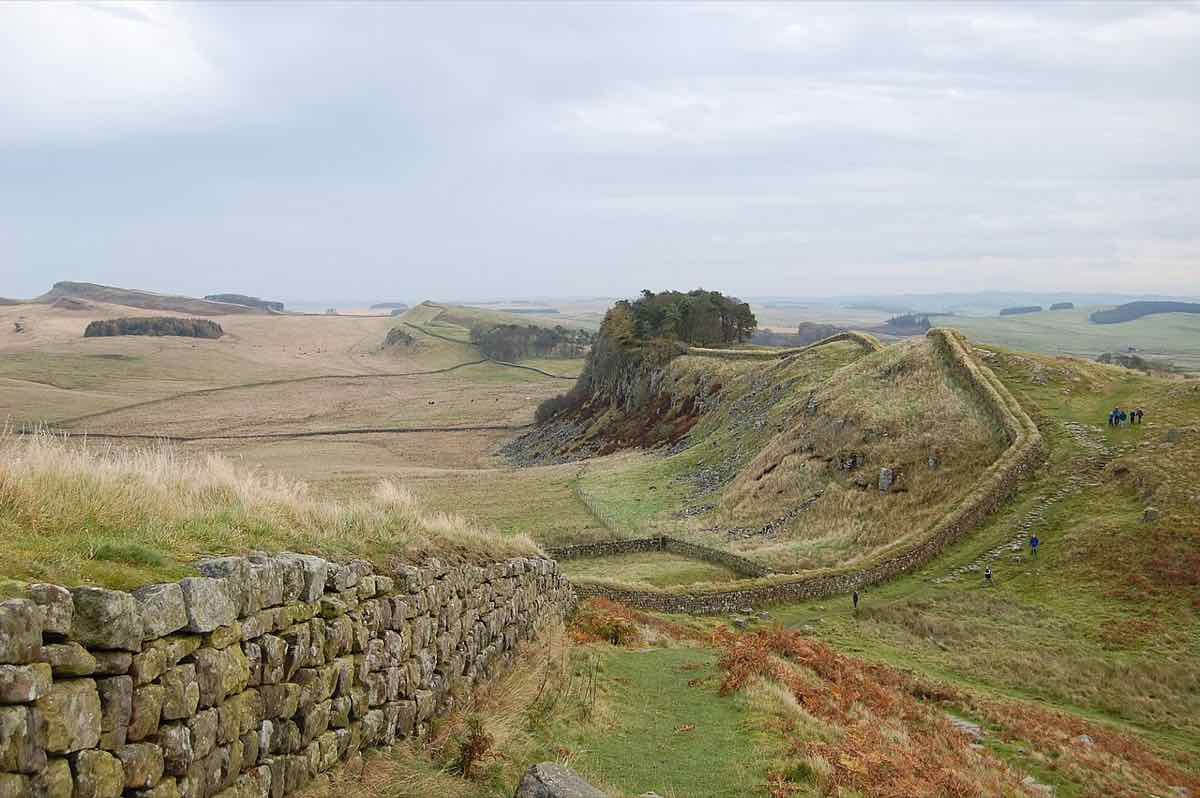
The Romans took over most of Britain, but they never conquered some parts of what is now Scotland. The Picts lived in the north, and they were among the ancestors of the Scottish people. To keep them out, the Emperor Hadrian had a wall built right across the north of England: Hadrian's Wall.
Several forts were built along the wall. Two of them, Housesteads and Vindolanda, can still be seen today. Walkers love the area, and it is a UNESCO World Heritage Site.
Vindolanda has given us a rare look at everyday life on the wall. Archaeologists dug up letters written in ink on thin slices of wood, the Vindolanda tablets, which are among the oldest handwritten documents in Britain. The best known, from around AD 100, is a birthday party invitation from Claudia Severa, a commander's wife, to her closest friend. It may be the oldest Latin we have written in a woman's own hand. Another letter shows that soldiers on the wall were sent underpants: northern England really is cold.
A stretch of Hadrian's Wall about a mile west of Housesteads fort.
Photo: Steven Fruitsmaak, public domain, via Wikimedia Commons
Quiz
Why did the Emperor Hadrian build a wall in the north of England?
Hadrian's Wall was built to keep out the Picts in the north. The Vikings did not appear until AD 789; you'll meet them in the next chapter.
What did the Romans leave behind?
The Romans stayed in Britain for about 400 years. During that time, they:
Built roads
Put up public buildings
Set up a system of law
Brought new plants and animals
Christianity also reached Britain during this time. The first Christian communities in Britain appeared in the 3rd and 4th centuries AD.
In AD 410, the Roman army left Britain to defend other parts of the empire, and it never came back.
With the Romans gone, Britain's door was open again. The next people to cross the sea were tribes from northern Europe, and the language they spoke would one day become English.
Quiz
Is the statement below TRUE or FALSE?
Roman rule in Britain lasted roughly four centuries, ending when the Roman army pulled out in AD 410 to protect other parts of the empire.
True. From AD 43 to 410 is roughly 400 years. A trick to remember it: AD 43 and 410 both start with a 4, and about 400 years lie between them.
Chapter summary
Hunter-gatherers
Britain's first people; in the Stone Age a land bridge joined Britain to the continent
10,000 years ago
The Channel separated Britain from mainland Europe for good
6,000 years ago
The first farmers arrived; their ancestors probably came from south-east Europe
Stonehenge
Wiltshire; a gathering place for seasonal ceremonies
Skara Brae
Orkney; northern Europe's best-preserved prehistoric village
Bronze Age
Began about 4,000 years ago; roundhouses, round barrows, fine work in bronze and gold
Iron Age
Iron tools, hill forts (Maiden Castle, Dorset), Celtic languages, the first coins with kings' names
55 BC Julius Caesar
Invaded, without success
AD 43 Claudius
A successful invasion; the Romans occupied most of Britain
Boudicca
Queen of the Iceni in eastern England, who fought the Romans; her statue is by Westminster Bridge
Hadrian's Wall
Built to keep out the Picts; forts at Housesteads and Vindolanda; a World Heritage Site
AD 410
The Romans stayed about 400 years (roads, buildings, law, plants and animals) and left in 410
 Built roads
 Put up public buildings
 Set up a system of law
 Brought new plants and animals