In England, the jury at a criminal trial is 12 people, and in the end they can only say "guilty" or "not guilty". Cross the border into Scotland and there are 15 jurors, and they have a third choice as well: "not proven".
Why does one country have courts that look so different? This chapter starts with the law you may meet in everyday life, moves on to what the police do and how independent judges are, and ends by laying the UK's three court systems side by side.
The starting point is simple: knowing the law and keeping to it is one of the biggest duties of anyone who lives in the UK. People from every background are welcome here, but some things that are allowed in other countries are simply not allowed in the UK. Anyone who doesn't respect the law can't count on being given permanent residence.
Equal before the law: criminal and civil law
The first principle of UK law is simple: everyone is equal before the law. Whoever you are and wherever you come from, the law treats you by the same rules as everyone else.
The law falls into two broad kinds:
Criminal law deals with crimes. Cases are usually investigated by the police, or sometimes by another authority such as the local council, and the courts decide on the punishment.
Civil law is for settling disagreements between people or between groups.
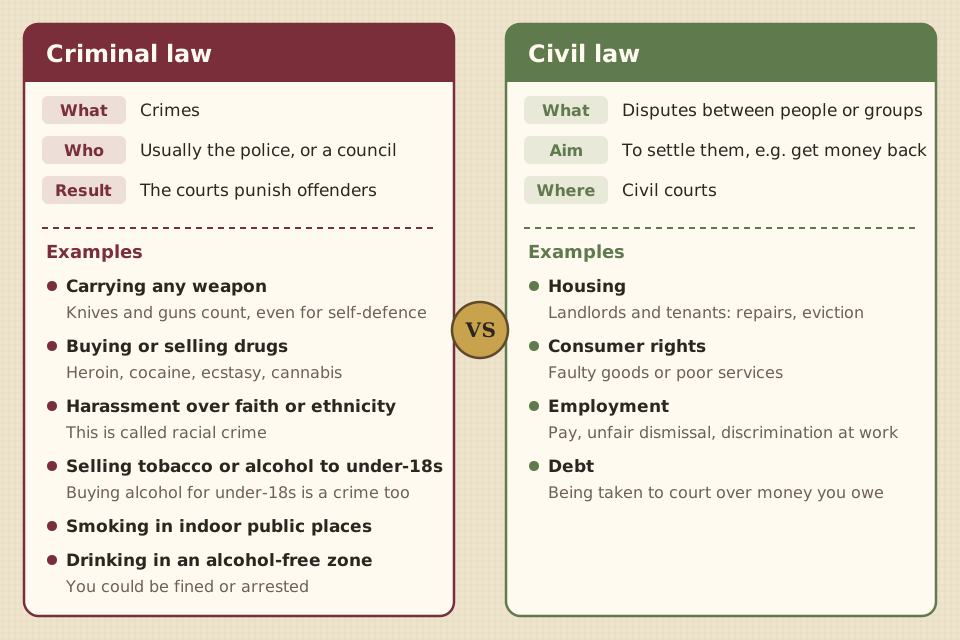
Criminal law is about crimes; civil law is about disputes. All the examples are in this chart.
These are crimes in the UK
Here are some things that newcomers might not expect to be against the law:
Carrying a weapon: carrying any kind of weapon is a crime, even if you say it's for self-defence. That includes guns, knives, and anything made or adapted to hurt someone.
Drugs: it is illegal to buy or sell drugs, including heroin, cocaine, ecstasy and cannabis.
Racial crime: it is a criminal offence to harass someone, frighten them or cause them distress because of their religion or ethnic origin.
Selling tobacco: you must not sell tobacco products such as cigarettes, cigars or roll-your-own tobacco to anyone under 18.
Smoking in public places: smoking is banned in almost every enclosed public place, and signs show you where you can't smoke.
Buying alcohol: it is a crime to sell alcohol to anyone under 18, or to buy it for them. There is one exception: people aged 16 or over may drink alcohol with a meal in a restaurant or hotel.
Drinking in public: some places are marked as an alcohol-free zone, where you can't drink in the street. The police can also take alcohol away, or tell young people to leave a public place. If you break these rules you could be fined or arrested.
Of course, this list isn't complete. Murder, theft, assault and the other things that are crimes in most countries are crimes in the UK too.
Some of these rules are newer than you might think. The ban on smoking indoors only came in during 2006 and 2007, starting in Scotland in March 2006 and finishing in England in July 2007. Before that, a smoky pub was one of the most familiar sights in Britain.
These are civil disputes
Housing: disagreements between landlords and tenants, for example about repairs or eviction (being made to leave).
Consumer rights: for example, buying something that turns out to be faulty, or a service that goes wrong.
Employment: disputes about pay, being unfairly dismissed, or discrimination at work.
Debt: if you owe someone money, they may take you to court.
Quiz
Which TWO of the following are criminal offences in the UK?
Carrying a weapon (even if you say it's for self-defence) and selling cigarettes to someone under 18 are both criminal offences. B is a housing dispute between a landlord and a tenant, and C is about consumer rights; both come under civil law.
Quiz
Is the statement below TRUE or FALSE?
A 16-year-old is allowed to have an alcoholic drink alongside a meal when eating in a restaurant or hotel.
True. This is the one exception. Apart from this, selling alcohol to anyone under 18, or buying it for them, is a crime.
The police: protecting everyone, and keeping to the law themselves
The job of the police in the UK comes down to three things:
Protecting life and property
Preventing disturbances (keeping the peace)
Preventing and detecting crime
The UK's police work in many separate forces, each led by a Chief Constable. The police are independent of the government.
In November 2012, people in England and Wales voted for the first time to elect Police and Crime Commissioners (PCCs). These directly elected commissioners are there to make sure the local police work well and meet the needs of the community. They set local policing priorities and the local policing budget, and they appoint the Chief Constable.
The police are a public service for everyone, whatever their background and wherever they live. The police must obey the law too. They must not misuse their powers, make false statements, be rude or abusive, or commit racial discrimination. Police officers who are corrupt or who misuse their authority are punished severely.
Working alongside the police are police community support officers (PCSOs). Their role varies from area to area, but usually they patrol the streets, work with the public, and support the police at crime scenes and big events.
Everyone should also do what they can to help the police prevent and detect crime. If the police arrest you and take you to a police station, they will tell you the reason, and you can ask for legal advice.
Most police in England, Wales and Scotland don't carry guns; Northern Ireland is the exception. In an emergency you call 999, which started in London in 1937 as the world's first emergency phone number. For things that aren't emergencies, call 101.
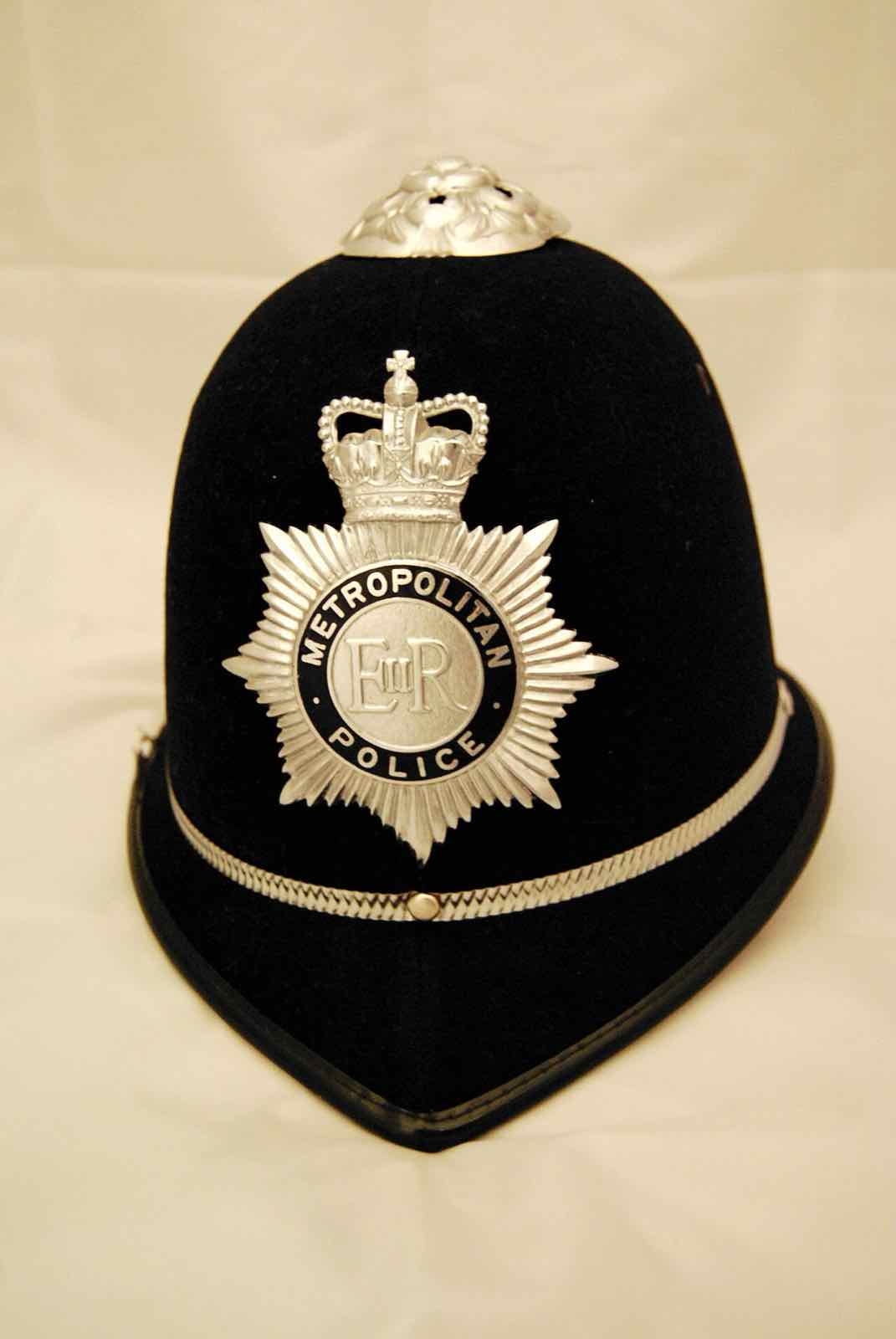
The traditional helmet of London's Metropolitan Police, the best-known look of the British police officer. British police officers are nicknamed "bobbies" after Robert Peel, the Home Secretary who set up London's Metropolitan Police in 1829. In the early days they were also called "peelers".
Photo: Canley, CC BY-SA 3.0, via Wikimedia Commons
Unhappy with the police? You can complain
When the police get things wrong, there is a complaints system to sort it out. Any member of the public can complain, either at a police station or by sending a letter to the Chief Constable of the force in question. Each part of the UK also has somewhere independent to turn:
England and Wales: an independent body that you can also complain to directly. Its website, policeconduct.gov.uk, belongs to the Independent Office for Police Conduct (IOPC).
Scotland: if you have already complained and you are not happy with how your complaint was dealt with, you can turn to the Police Investigations and Review Commissioner (PIRC).
Northern Ireland: the Police Ombudsman's Office.
Quiz
Which TWO of the following are duties of the police in the UK?
The police have three duties: protecting life and property, preventing disturbances, and preventing and detecting crime. The local policing budget is set by the elected Police and Crime Commissioner (PCC), and after someone is found guilty, the sentence is decided by a judge or magistrate.
Quiz
Since November 2012, voters in England and Wales have elected officials who decide local policing priorities and appoint the Chief Constable. What are these officials called?
Police and Crime Commissioners (PCCs) are directly elected. Justices of the Peace (JPs) hear minor criminal cases in Scotland; police community support officers (PCSOs) help the police by patrolling; and a sheriff is a judge in a Scottish Sheriff Court.
Quiz
In Northern Ireland, which independent body can people go to with a complaint about the police?
In Northern Ireland, complaints about the police go to the Police Ombudsman. The Police Investigations and Review Commissioner is Scotland's body, for people unhappy with how a complaint was handled. The Equality Commission for Northern Ireland deals with discrimination, not the police, and the Crown Court tries serious criminal cases.
Terrorism and extremism
The UK faces several kinds of terrorist threat. The most serious comes from Al Qa'ida, the groups linked to it, and organisations that share its ideas. There is also terrorism connected with Northern Ireland.
All terrorist groups try to radicalise people (turn them towards extreme views) and then recruit them, though their methods, places and scale differ. The evidence shows that these groups have very little support from the public. Even so, people planning to settle in the UK still need to know about the threat.
Every citizen should feel safe, and that includes being safe from extremism of any kind. Extremism means speaking or acting against the UK's fundamental values. This covers religious extremism and far-right extremism alike.
If you believe someone is trying to pull you into an extremist or terrorist group, tell your local police.
Quiz
Which of the following statements is correct?
Terrorist groups have very little public support. If someone tries to pull you into an extremist or terrorist group, tell the local police.
Judges: not even the government can interfere
Together, judges are called the judiciary. Their job is to interpret the law and make sure trials are fair, and the government cannot interfere with their work.
How much power do judges have?
If someone claims the government has acted illegally, and the judges agree, the government must either change its policy or ask Parliament to change the law.
If judges decide that a public body has not respected someone's legal rights, they can order it to change the way it acts, or to pay compensation, or both.
Judges also settle disputes between people or organisations, for example about contracts, property, employment rights, or what happens after an accident.
One thing British judges never do is bang a gavel. The wooden hammer is a fixture of American TV dramas, but courts in England and Wales don't have them at all; the fact-checking charity Full Fact even wrote an article in 2014 to clear up the mistake. In British courts, the famous look is wigs and gowns.
Quiz
Which of the following statements is correct?
Judges are independent: the government cannot interfere with them. If judges find the government has acted illegally, the government can only change its policy or ask Parliament to change the law.
Criminal courts: three systems side by side
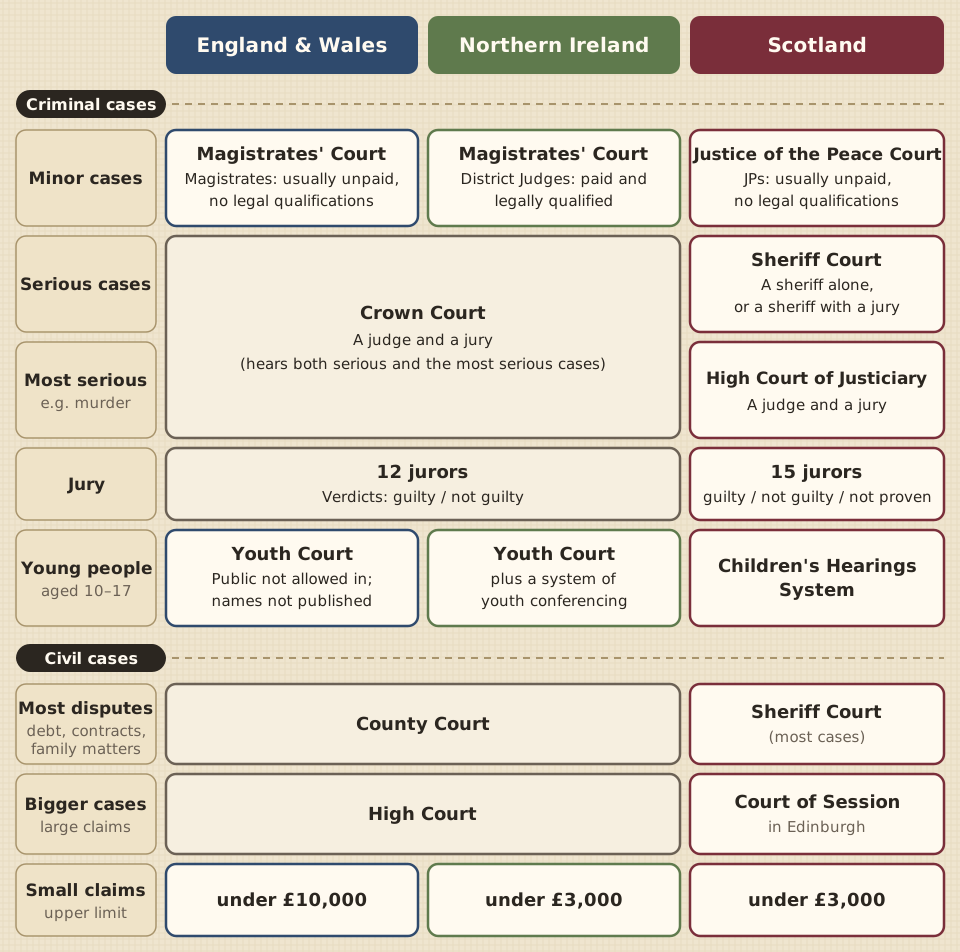
The UK doesn't have one court system but three: one for England and Wales, one for Scotland and one for Northern Ireland. They work in broadly the same way, but the names and details are different. These differences are a favourite in the test, so start with the chart below to see the whole picture.
The three court systems at a glance. Grey boxes are shared by England, Wales and Northern Ireland; red boxes are found only in Scotland.
Minor cases: over to the magistrates
Most minor criminal cases in England, Wales and Northern Ireland go to a Magistrates' Court. In Scotland, minor criminal cases go to a Justice of the Peace Court.
A magistrate, or in Scotland a Justice of the Peace (JP), is an ordinary local resident. Magistrates and JPs in England, Wales and Scotland usually receive no pay, and they don't need any legal qualifications. They are trained, and a legal adviser helps them in court. They decide whether the accused person is guilty, and if so, what the punishment should be.
Northern Ireland is different. There, a District Judge or a Deputy District Judge hears the case. These judges are paid, and they have legal qualifications.
This is where most criminal justice really happens. According to the website of the judiciary of England and Wales, almost every criminal case starts in a Magistrates' Court, and around 95% finish there too. The big TV-style trial with twelve jurors is actually quite rare.
Quiz
In Scotland, which court hears minor criminal offences?
In Scotland, minor criminal cases go to the Justice of the Peace Court. The Magistrates' Court is for England, Wales and Northern Ireland; the Crown Court tries serious criminal cases; and the County Court is a civil court.
Serious cases: enter the jury
In England, Wales and Northern Ireland, serious criminal cases are tried in the Crown Court, by a judge and a jury.
Serious cases in Scotland go to a Sheriff Court, either by a sheriff (a judge) alone or by a sheriff with a jury. The most serious cases, such as murder, go to the High Court of Justiciary (often just called the High Court), where they are heard by a judge and a jury.
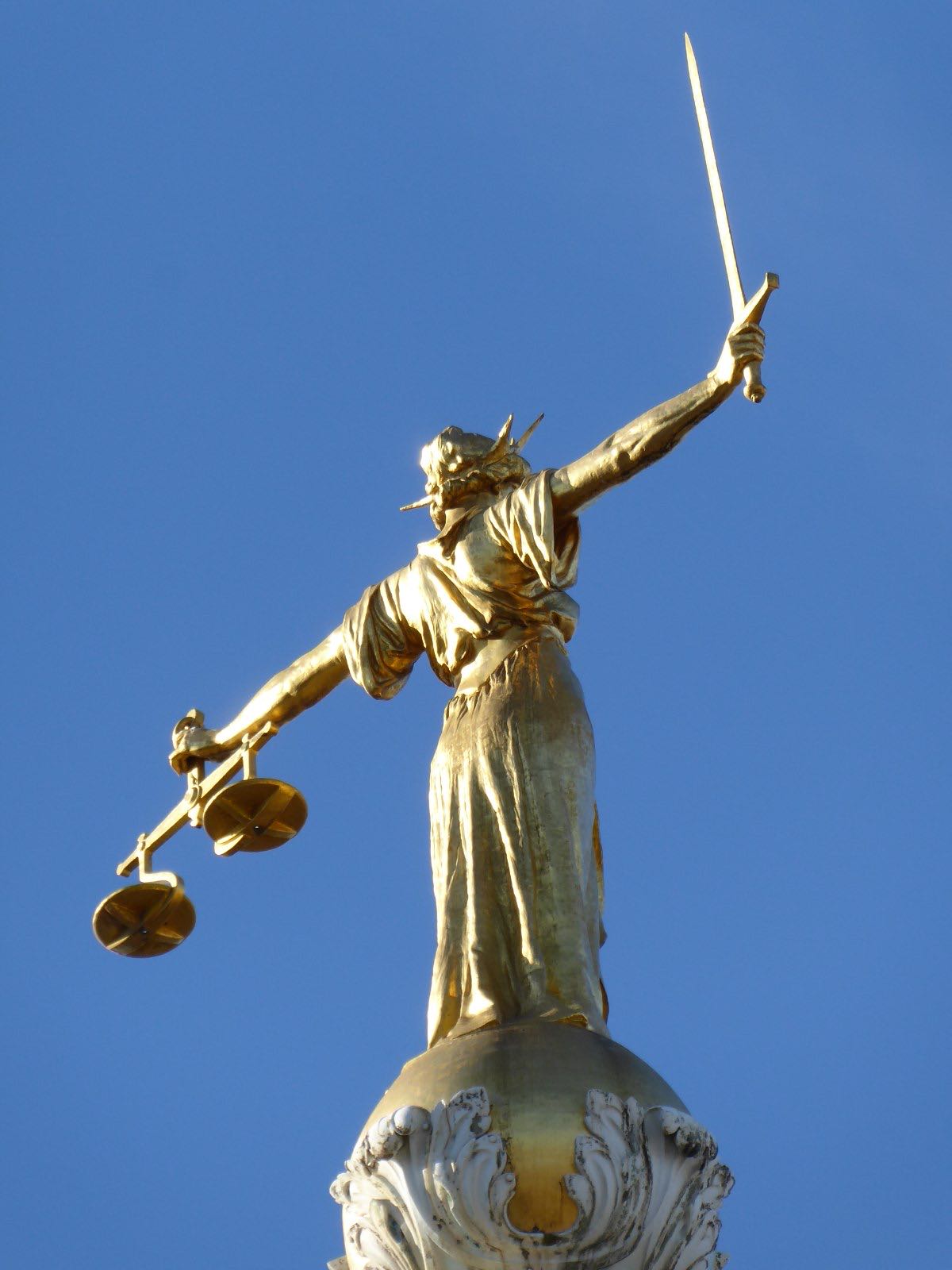
The Central Criminal Court in London, known as the Old Bailey. On top of the dome, Lady Justice holds a sword in her right hand and scales in her left. Unlike many statues of Lady Justice, this golden figure from the early 1900s wears no blindfold. Many famous trials have taken place in the court below.
Photo: Philip Halling / Geograph, CC BY-SA 2.0, via Wikimedia Commons
A jury is a group of ordinary people, picked at random from the local electoral register (the list of voters):
England, Wales and Northern Ireland: 12 people
Scotland: 15 people
If you receive a summons (an official letter calling you), you must serve on the jury, unless you are not eligible (for example, because you have a criminal record) or you have a good reason to be excused (for example, illness). Jurors listen to the evidence in court and then reach a verdict of "guilty" or "not guilty". In Scotland there is a third possible verdict: "not proven". If the jury finds someone guilty, the judge decides the punishment, not the jury.
Who can be picked, and at what age you can serve, are covered in the next chapter, Your Role in the Community.
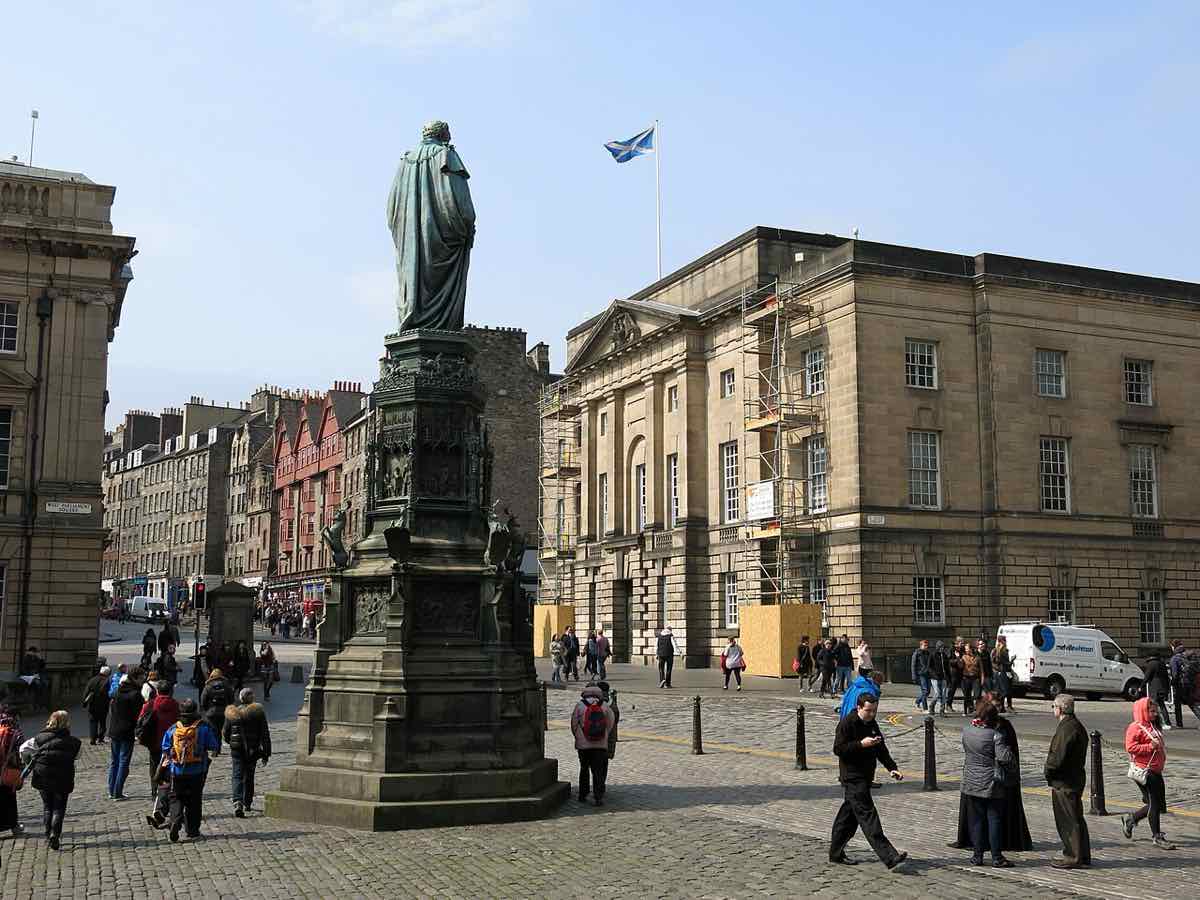
The Justiciary Building beside the Royal Mile in Edinburgh, where Scotland's High Court of Justiciary sits. When it was finished in 1937 it was the Sheriff Court; in the early 1990s it was handed over to the High Court.
Photo: Enric, CC BY-SA 4.0, via Wikimedia Commons
Quiz
Which TWO statements about juries are correct?
Juries in England, Wales and Northern Ireland have 12 members; in Scotland they have 15. The jury only decides guilty or not guilty: the judge decides the punishment.
Youth Courts
In England, Wales and Northern Ireland, defendants aged 10 to 17 usually have their case heard in a Youth Court. It is run by up to three specially trained magistrates, or by a District Judge. The most serious cases still go to the Crown Court.
Youth Courts have some special rules:
The young person's parents or carers are expected to be there.
Members of the public are not allowed in.
Newspapers and other media must not publish the young person's name or photograph.
Scotland uses the Children's Hearings System for children and young people who have broken the law. Northern Ireland has a system of youth conferencing to decide how to deal with young people who offend.
Youth Courts start at 10 because that is the age of criminal responsibility in England, Wales and Northern Ireland.
Quiz
Is the statement below TRUE or FALSE?
Anyone from the public can sit in a Youth Court and newspapers may print the young defendant's name.
False. Youth Courts are closed to the public, and the media cannot publish the young defendant's name or photo. The people who should be there are the child's parents or carers.
Civil courts and small claims
Civil cases have their own courts:
The County Court deals with a wide range of civil disputes, such as getting back money you are owed, personal injury, family matters, broken contracts and divorce. In Scotland, most of these cases are dealt with in the Sheriff Court.
In England, Wales and Northern Ireland, bigger civil cases, for example where a large amount of compensation is claimed, go to the High Court. Scotland's equivalent is the Court of Session in Edinburgh.
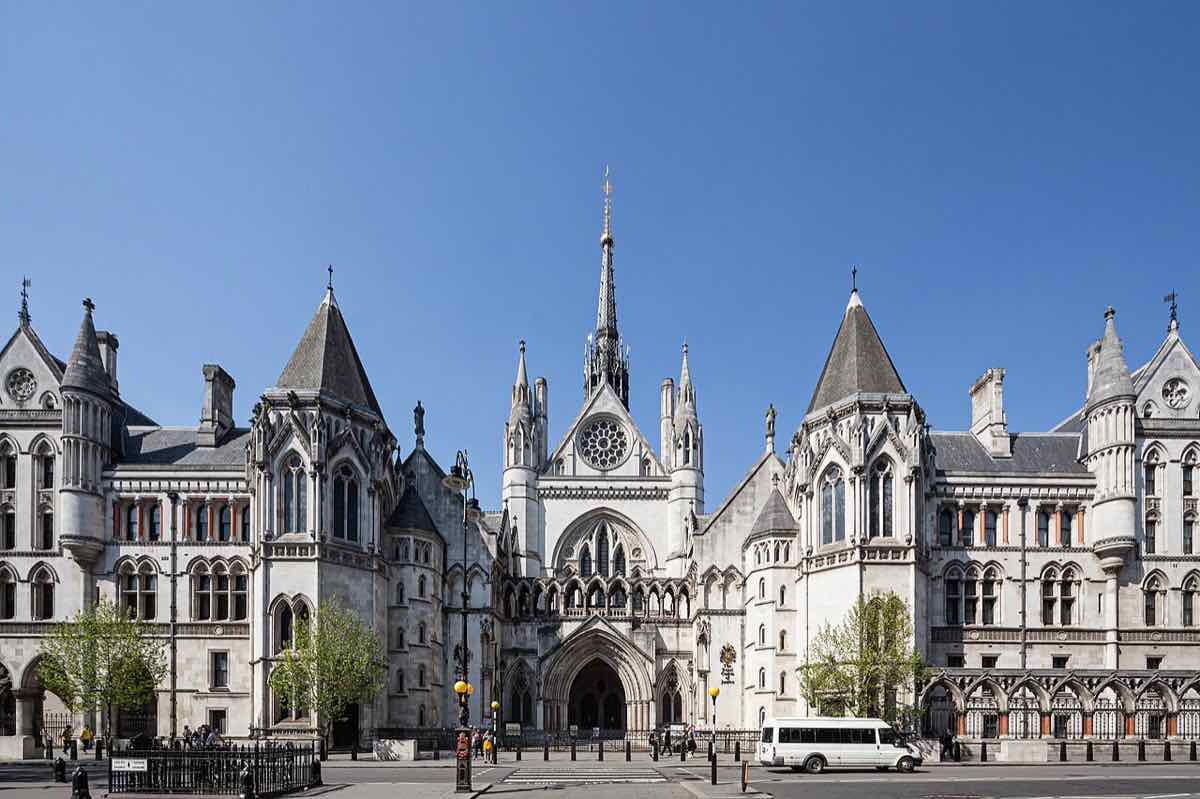
The Royal Courts of Justice on the Strand in London, where the High Court of England and Wales sits.
Photo: David Castor, CC0, via Wikimedia Commons
Small claims: sorting it out round a table
The small claims procedure is an informal way to settle smaller disputes without spending lots of money and time on a lawyer.
Limits: in England and Wales, claims under £10,000; in Scotland and Northern Ireland, claims under £3,000.
A judge hears the case in an ordinary room, with everyone sitting round a table.
You can also make a claim online using Money Claims Online.
For more details, ask your local County Court or Sheriff Court. Information for England and Wales is on the UK government website (GOV.UK); Scotland and Northern Ireland each have their own courts websites.
Quiz
Which TWO statements about civil cases are correct?
In Scotland, serious civil cases go to the Court of Session in Edinburgh. Small claims are informal: a judge hears them in an ordinary room, round a table. The £10,000 limit is for England and Wales; in Scotland and Northern Ireland it is £3,000. Divorce is a civil matter for the County Court; the Youth Court tries criminal cases against 10- to 17-year-olds.
Getting a lawyer: solicitors
A solicitor is a trained lawyer who gives legal advice, takes legal action for their clients and can speak for them in court. There are solicitors' offices all over the UK.
When you look for a solicitor:
First check which areas of law they specialise in, and whether they have dealt with cases like yours.
Many solicitors advertise in local newspapers.
The charity Citizens Advice can give you the names of local solicitors and the areas they work in. You can also ask the solicitors' professional bodies: the Law Society for England and Wales, the Law Society of Scotland, and the Law Society of Northern Ireland.
Fees are usually based on the time spent on your case, so ask at the very start roughly how much it is likely to cost.
Quiz
Is the statement below TRUE or FALSE?
A solicitor's fees usually depend on how many hours they work on your case, so you should ask about the likely cost at the beginning.
True. Solicitors usually charge by the time they spend, so you should find out the likely cost at the start. A common wrong option says fees depend on how important the case is.
Chapter summary
Criminal vs civil law
Criminal law deals with crimes (investigated by the police, punished by the courts); civil law settles disputes between people or groups
Weapons
Carrying any weapon is illegal, even for self-defence
Under 18
Can't be sold tobacco or alcohol, and nobody may buy alcohol for them; 16+ may drink with a meal in a restaurant or hotel
Police duties
Protect life and property, prevent disturbances (keep the peace), prevent and detect crime
PCCs (Nov 2012)
Police and Crime Commissioners: elected in England and Wales; set policing priorities and budgets; appoint the Chief Constable
PCSOs
Police community support officers: patrol, work with the public, support the police
Police complaints
A police station or the Chief Constable; independent bodies: policeconduct.gov.uk (England and Wales), the Police Investigations and Review Commissioner (Scotland, if unhappy with how a complaint was handled), the Police Ombudsman (Northern Ireland)
Terrorism
Most serious threat: Al Qa'ida; also terrorism linked to Northern Ireland. If someone tries to draw you in, tell the local police
Judiciary
Interpret the law and keep trials fair, free from government interference; if they rule the government acted illegally, it must change policy or ask Parliament to change the law
Minor crimes
Magistrates' Court (England, Wales, NI); Justice of the Peace Court (Scotland). Magistrates are unpaid and not legally qualified; in NI, paid District Judges
Serious crimes
Crown Court with a jury; in Scotland, the Sheriff Court, with the most serious (murder) in the High Court
Jury
Picked at random from the electoral register; 12 people, 15 in Scotland; Scotland also has "not proven"; the judge sets the sentence
Youth Court
Ages 10–17; up to three magistrates or a District Judge; no public, no names published. Scotland: Children's Hearings System
Civil courts
County Court (Scotland: Sheriff Court); bigger cases: High Court (Scotland: Court of Session, Edinburgh)
Small claims
Informal, round a table; under £10,000 in England and Wales, under £3,000 in Scotland and Northern Ireland
Solicitors
Charge by time spent; ask about the cost at the start
 Protecting life and property
 Preventing disturbances (keeping the peace)
 Preventing and detecting crime