The British Constitution: A Country Without a Written Constitution
Ask a British friend what Article 1 of their constitution says, and they probably won't be able to tell you. That's not because they weren't paying attention at school. It's because Britain has no single legal document called "the Constitution" at all.
So how does a country work without one? This chapter first looks at how Britain slowly became a democracy where every adult can vote. Then it looks at the institutions that keep the country running: the monarch, Parliament, the Prime Minister, the cabinet, the opposition, the civil service and local government. The two Houses of Parliament, the Speaker and elections are covered in more detail in the next chapter.
One sentence sums up the key idea of the whole chapter: the UK is a parliamentary democracy, and its head of state is the monarch.
The vote was won a little at a time
In a democracy, all adults have a voice in how the country is run. They might vote on decisions themselves, or elect people to decide for them.
At the start of the 19th century, though, Britain was not a democracy in today's sense. There were elections, and members of parliament (MP) were chosen, but only a small group of people could vote: men over 21 who owned a certain amount of property.
As the century went on, the right to vote (the franchise) was given to more and more people, and political parties started to welcome ordinary men and women as members.
The Chartists' six demands
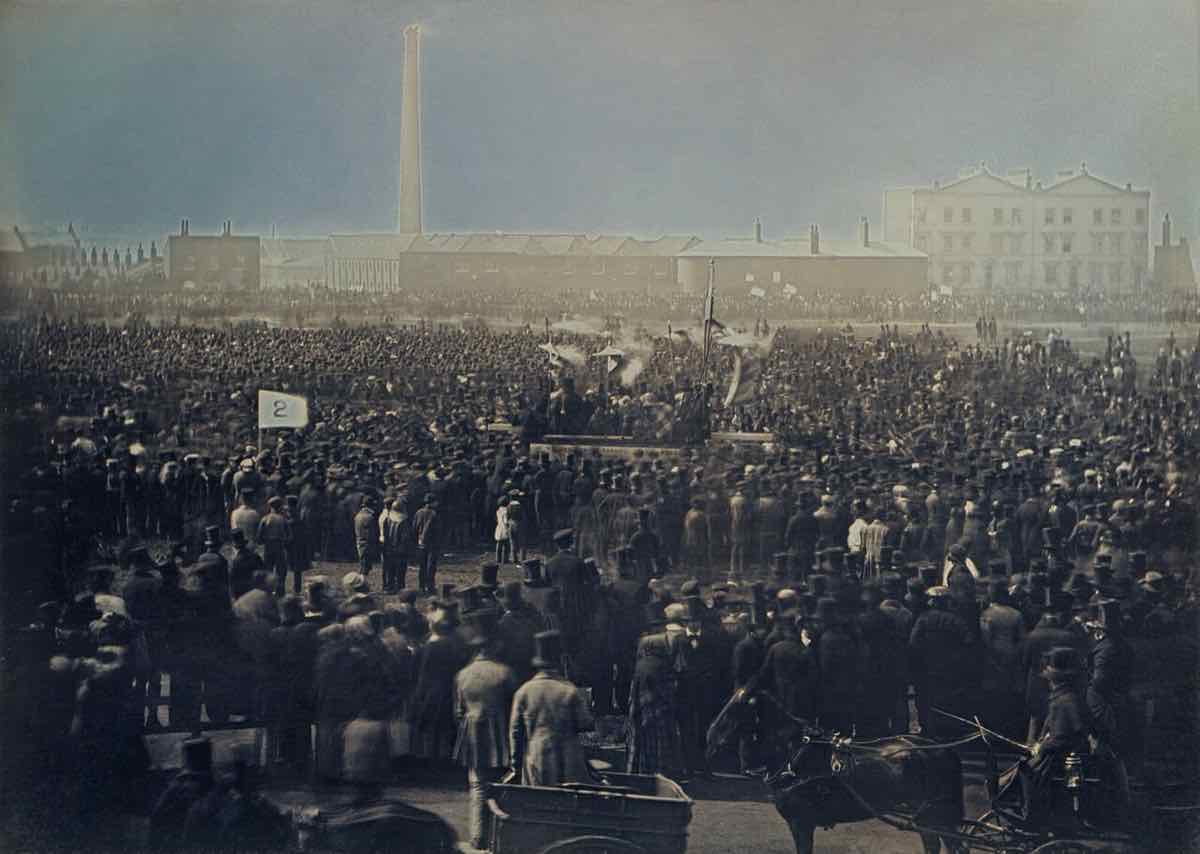
In the 1830s and 1840s, a group known as the Chartists campaigned for reform. They wanted six changes:
1A vote for every man
2An election every year
3Every region treated equally in the voting system
4Secret ballots
5Any man able to stand as an MP
6Pay for MPs
At the time, most people thought the movement had failed. Yet by 1918, most of these reforms had come true.
The great Chartist meeting on Kennington Common in London, 10 April 1848. It is one of the earliest photographs ever taken of a large crowd.
Photo: William Edward Kilburn, public domain, via Wikimedia Commons
The Chartists' demands were then met one by one: no property was needed to become an MP from 1858, voting became secret in 1872, MPs were first paid in 1911, and all adult men had the vote by 1918. Constituencies were also made more equal in size in the late 19th century. Only one demand never came true, a new election every year. A UK General Election still has to be held at least every five years, not every year.
From a few men to everyone aged 18
1800Early 1800s: only men over 21 who own a certain amount of property can vote
1830s1830s and 1840s: the Chartists demand six reforms; at the time they are thought to have failed
1918Most of the Chartists' reforms are now in place, and women over 30 get the vote
1928Men and women over 21 can all vote, on equal terms
1969The voting age is lowered to 18 for men and women alike
Quiz
In 1928, who gained the right to vote?
Keep the three years apart: 1918, women over 30; 1928, men and women over 21; 1969, lowered to 18. A vote only for men with property was the situation at the start of the 19th century.
Quiz
Which TWO of these changes did the Chartists campaign for?
Pay for MPs and secret ballots were two of the six demands. The Chartists wanted a vote for every man; they did not ask for votes for women, and women over 30 only got the vote in 1918. They didn't call for an end to the monarchy either.
Quiz
Is the statement below TRUE or FALSE?
The voting age for both men and women was lowered to 18 in 1969.
True: the voting age became 18 in 1969.
A constitution that isn't written down
A constitution is the rulebook for how a country is governed. It covers every institution that helps to run the country and the ways their power is kept under control. It also includes laws and conventions (customs that everyone follows, even though they aren't written in law).
The UK's constitution is not set out in one single document, so people describe it as an unwritten constitution. The main reason is that, unlike the USA or France, Britain has never had a revolution that swept away its whole system of government for good. Instead, its most important institutions grew up slowly over hundreds of years.
Should the constitution be written down in one place? British people don't agree. Some think it should be. Others feel that an unwritten constitution is more flexible and helps government to work better.
Having no single document doesn't mean having no rules. Britain's constitution is spread across many sources: Magna Carta from 1215, the Bill of Rights from 1689, laws passed by Parliament over the years, decisions made by the courts, and conventions that everyone quietly follows. Only a handful of countries, such as New Zealand and Israel, also manage without one written constitution.
The institutions that hold the country together
The UK's system of government has several parts. The main ones are:
the monarchy
Parliament, made up of the House of Lords and the House of Commons
the Prime Minister
the cabinet
the judiciary, meaning the courts
the police
the civil service
local government
On top of this, Scotland, Wales and Northern Ireland have devolved governments, which can make their own laws on some subjects.
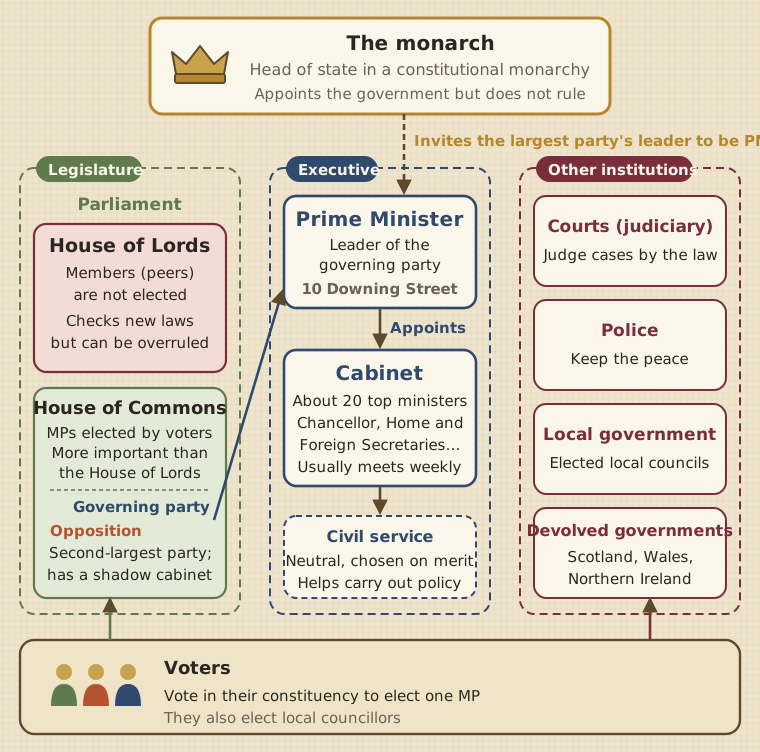
How the parts of UK government fit together. Voters elect MPs to the House of Commons, the monarch invites the leader of the largest party to be Prime Minister, and the Prime Minister then appoints the cabinet.
Quiz
Which of the following statements is correct?
It's the other way round. Britain has no written constitution precisely because it never had a revolution that started its system again from scratch. The USA and France are the examples of countries that wrote a constitution after a revolution.
The monarch: reigning, not ruling
The monarch is the UK's head of state, and is also the monarch or head of state of many countries in the Commonwealth.
Britain's system is a constitutional monarchy. In practice, this means the king or queen does not run the country. Voters choose the government at elections, and the monarch formally appoints it. After an election, the monarch asks the leader of whichever party has the most MPs, or the leader of a coalition (two or more parties governing together), to become Prime Minister.
The monarch and the Prime Minister meet regularly. The monarch may give advice, warnings or encouragement, but it is the Prime Minister and cabinet who decide the government's policies.
Elizabeth II has held these meetings with every Prime Minister since Winston Churchill. They are private and no record is kept, so nobody outside knows exactly what "warnings" a monarch has ever given.
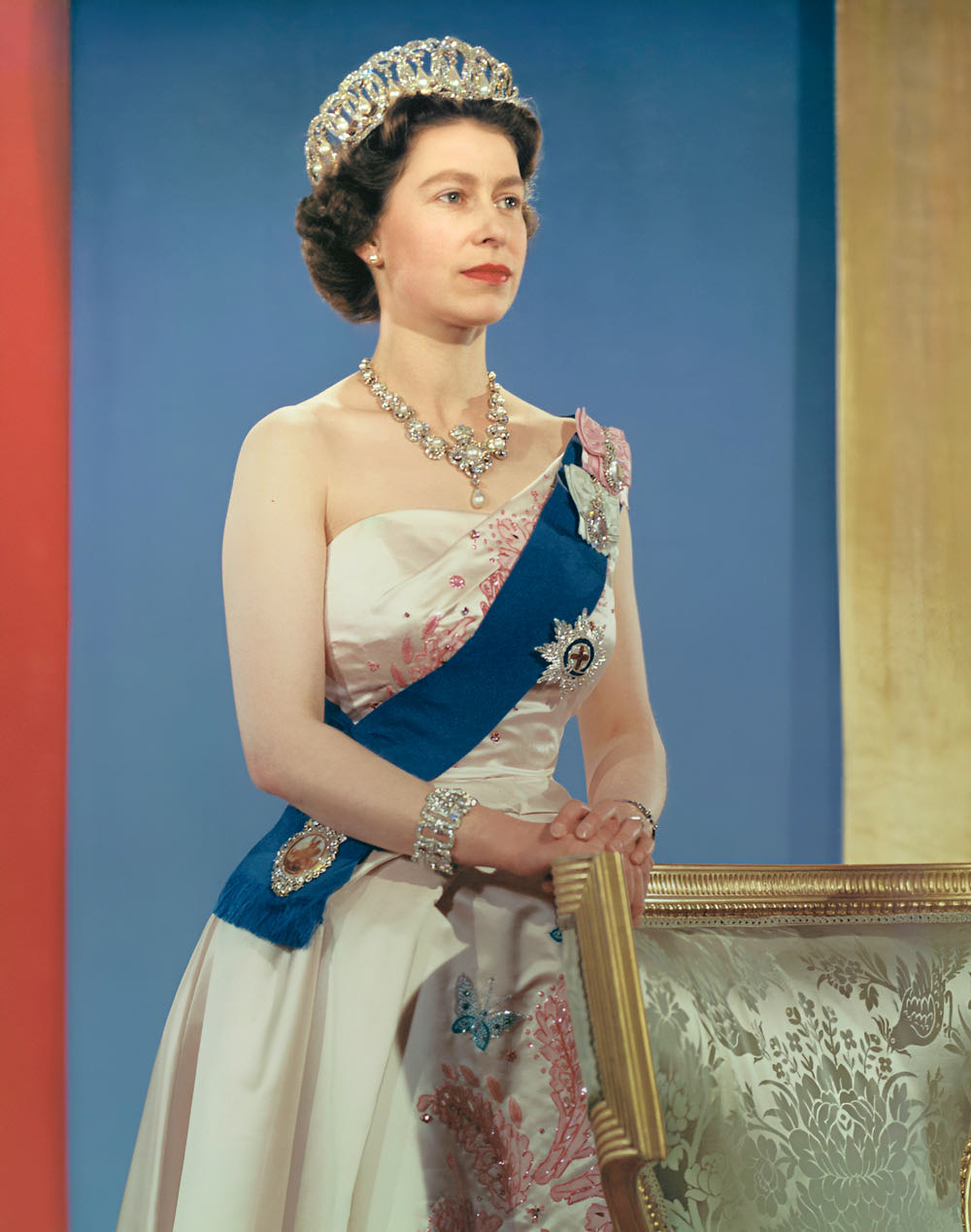
Elizabeth II's official portrait, taken in 1959 before a royal tour of Canada.
Photo: Donald McKague, Library and Archives Canada, public domain, via Wikimedia Commons
Elizabeth II became queen in 1952, after her father died, and in 2012 she celebrated her Diamond Jubilee, marking 60 years on the throne. Her husband was Prince Philip, and Prince Charles, the Prince of Wales and her eldest son, was next in line to the throne.
What does the monarch do?
Ceremonies: every year the monarch opens the new session of Parliament with a speech that sets out the government's plans for the year ahead. Every Act of Parliament (Acts of Parliament) becomes law in the monarch's name.
Representing the UK: the monarch welcomes ambassadors and high commissioners (the Commonwealth's version of ambassadors) from other countries, hosts foreign heads of state when they visit, and travels abroad on official visits to strengthen Britain's diplomatic and trade links.
Stability and continuity: Prime Ministers and governments change often, while the monarch stays in place as head of state. The monarch also gives people a shared symbol of national identity and pride, as the countrywide Diamond Jubilee celebrations in 2012 showed.
The national anthem and the citizenship oath
The UK's national anthem is God Save the Queen. You hear it at major national events, and whenever the Queen or other members of the Royal Family are present. The first verse opens with the line God save our gracious Queen and asks God to give the monarch a long, victorious reign.
At a citizenship ceremony, new citizens make a promise of loyalty to the monarch, either as an oath or as an affirmation. Both say the same thing; the only difference is whether God is mentioned:
Oath of allegiance (Oath of allegiance)
Uses the word swear: you promise by Almighty God that, once you are a British citizen, you will be loyal to the monarch and the monarch's heirs, as the law requires. For people who are happy to make a promise before God
Affirmation of allegiance (Affirmation of allegiance)
Uses the word affirm: God is not mentioned; you declare seriously and sincerely that, once you are a British citizen, you will be loyal to the monarch and the monarch's heirs, as the law requires. For people who prefer not to make a religious promise
Formal citizenship ceremonies are fairly new. The first was held in 2004, at Brent Town Hall in London. Before that, new citizens took the oath privately in front of someone authorised to hear it, and their certificate arrived later by post. Today local councils usually organise the ceremonies, and the national anthem is played at them.
Quiz
What does it mean to say that the UK is a constitutional monarchy?
In a constitutional monarchy the monarch is head of state but does not run the country; the government is elected. The leader of the largest party is the Prime Minister, not the monarch.
Quiz
Is the statement below TRUE or FALSE?
After the regular meetings with the Prime Minister, the monarch decides what the government's policies will be.
False. The monarch can only advise, warn and encourage. The Prime Minister and the cabinet decide the government's policies.
Quiz
Which TWO of these are roles of the monarch?
Keeping order in Commons debates is the job of the Speaker, whom you'll meet in the next chapter. The shadow cabinet is led by the leader of the opposition.
Parliamentary democracy: voters → MPs → government
Britain is run as a parliamentary democracy. The whole country is split into areas called constituencies. At a General Election, the people living in each constituency choose one MP to represent them, and together these MPs make up the House of Commons.
Nearly every MP belongs to a political party. Whichever party has more than half of the MPs forms the government. If no party has over half, two parties may agree to govern together as a coalition (coalition).
Look back at the diagram above: voters elect MPs → the monarch invites the leader of the largest party in the Commons to be Prime Minister → the Prime Minister appoints the cabinet. Let's start with the Prime Minister.
The Prime Minister and the cabinet
The Prime Minister (Prime Minister, or PM) leads whichever party is in power. The PM chooses the members of the cabinet and has the final say over many important public jobs.
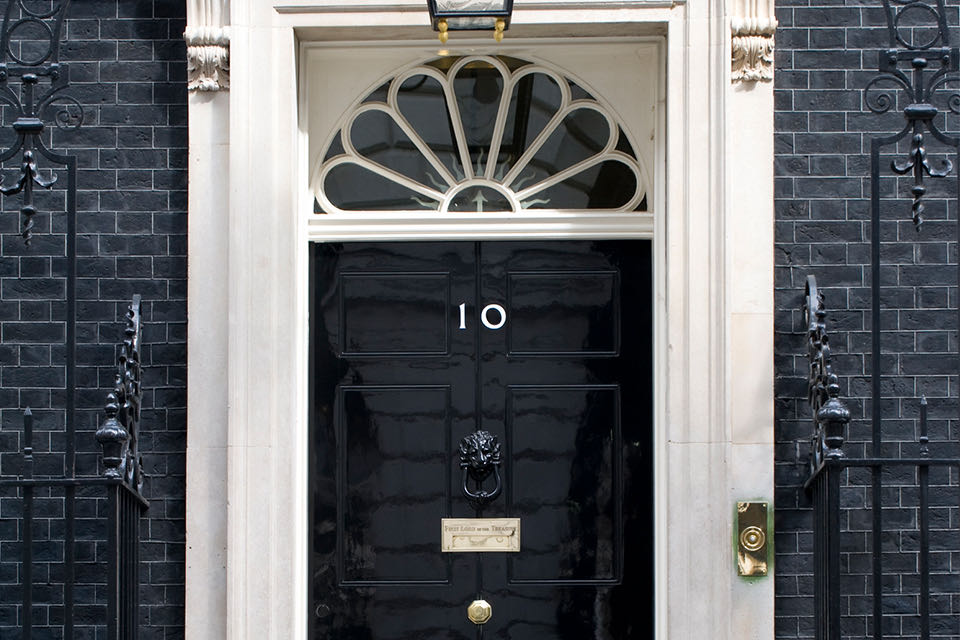
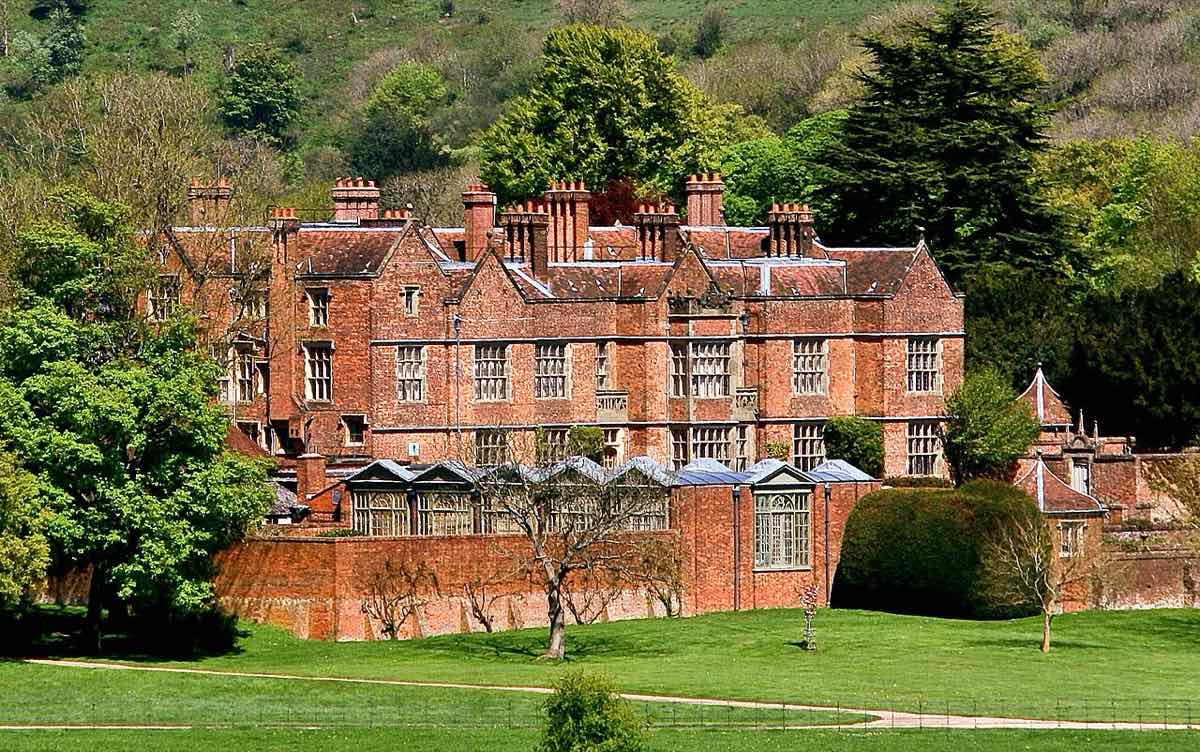
The PM lives and works at 10 Downing Street (10 Downing Street), a short walk from the Houses of Parliament in central London. The PM also has the use of a country house outside London, called Chequers (Chequers).
The front door of 10 Downing Street. It has no keyhole on the outside, because someone is always inside to open it. Larry the cat lives here too, and has been "Chief Mouser to the Cabinet Office" since 2011, outlasting several Prime Ministers.
UK Government, Open Government Licence v3.0, via Wikimedia CommonsChequers, the Prime Minister's country house. Lord Lee of Fareham gave it to the nation, and Prime Ministers have used it since 1921.
Photo: Cnbrb, CC0, via Wikimedia Commons
A Prime Minister doesn't always stay until the next election. MPs from the governing party can decide to replace their leader, or the PM may choose to step down. And if the governing party is defeated at a General Election, the PM normally resigns.
The cabinet: about 20 senior ministers
The PM picks around 20 senior MPs to run government departments as ministers. Among them are:
the Chancellor of the Exchequer (Chancellor of the Exchequer), in charge of the economy
the Home Secretary (Home Secretary), in charge of crime, policing and immigration
the Foreign Secretary (Foreign Secretary), who deals with Britain's relations with other countries
other ministers, known as Secretaries of State, who cover areas such as education, health and defence
This group of ministers is called the cabinet (cabinet). It normally meets every week to make the most important decisions about government policy, and Parliament often has to discuss or vote on those decisions.
Below the cabinet ministers, every department has more junior ministers, with titles such as Ministers of State or Parliamentary Under-Secretaries of State. Each of them handles one part of the department's work.
The Chancellor's odd title goes back to a medieval royal finance office. Its officials did their sums and collected taxes at a table covered with a chequered cloth, moving counters around on it rather like pieces in a board game, and that cloth gave the Exchequer its name.
Quiz
What is the name of the Prime Minister's country house outside London?
It's Chequers. Balmoral, Sandringham and Windsor Castle are all royal homes, not the Prime Minister's.
Quiz
Which member of the cabinet is in charge of the economy?
The Chancellor of the Exchequer is responsible for the economy. The Home Secretary deals with crime, policing and immigration, and the Foreign Secretary with other countries. The Speaker isn't in the cabinet at all: the Speaker chairs debates in the House of Commons.
The opposition, political parties and pressure groups
The opposition and the shadow cabinet
In the House of Commons, the party with the second-highest number of MPs is known as the opposition (the opposition). Its leader normally becomes Prime Minister if the party wins the next General Election.
The opposition's job is to keep the government on its toes. Its leader heads the party's criticism of anything they think the government is getting wrong or doing badly. A key moment for this is Prime Minister's Questions, held once a week whenever Parliament is sitting. The opposition leader also gives senior MPs from their own party the role of "shadow ministers". Together they make up the shadow cabinet (shadow cabinet), which challenges the government and offers different policies.
The opposition's official name is Her Majesty's Most Loyal Opposition, because opposing the government is not the same as being disloyal to the country. Prime Minister's Questions now takes place at midday on Wednesdays. It used to be two short sessions a week, until Tony Blair made it one longer Wednesday session after he became Prime Minister in 1997; it moved to midday in 2003, when the Commons changed its sitting hours.
The party system
You can stand for election as an MP from the age of 18. In practice, though, candidates rarely win unless one of the main parties has chosen them. The main parties are the Labour Party, the Conservative Party and the Liberal Democrats, plus parties that speak up for Scotland, Wales or Northern Ireland.
A few MPs are independents (independents): they aren't part of any main party, and they usually campaign on one issue that matters in their local area.
The big parties are always keen for ordinary people to get involved: to take part in discussions, donate money, and help during national and local election campaigns. Most constituencies have a local branch of each main party, and each party holds a conference every year to agree its policies.
Pressure and lobby groups
Pressure and lobby groups are organisations that try to change what the government does, and they matter a lot in British politics. Some speak for a particular part of society: for example, the CBI (Confederation of British Industry) gives the views of British business. Others campaign on one cause, such as Greenpeace on the environment, or Liberty on human rights.
Quiz
How often does Prime Minister's Questions take place while Parliament is sitting?
Prime Minister's Questions is held every week while Parliament is sitting. It is one of the main chances for the leader of the opposition to challenge the government over its failures and weaknesses. It is not a daily event, and it happens far more often than once a month or once a year.
Quiz
Which of the following statements is correct?
The leader of the opposition picks the shadow cabinet from their own party. The Prime Minister appoints the real cabinet.
The civil service: the team that stays when governments change
Prime Ministers and ministers come and go with elections, but most of the people who work in government departments stay. They are civil servants, permanent government staff who:
help ministers to shape policies and put them into practice, and also run public services;
report to ministers;
are hired for their ability, not their politics, and must stay politically neutral: no party appoints them;
can join by applying, just as for any other job.
Civil servants are expected to be committed to their work and to follow four core values: integrity (integrity), honesty (honesty), objectivity (objectivity: judging on the facts) and impartiality (impartiality: not taking sides, which includes being politically neutral).
The relationship between ministers and civil servants was famously sent up in the 1980s sitcom Yes Minister, in which a newly appointed minister is always being politely steered in the "right" direction by his experienced senior civil servant. Margaret Thatcher, Prime Minister at the time, reportedly called it her favourite programme.
Quiz
Which TWO of these statements are correct?
Civil servants aren't appointed by a party, so they don't change when the government changes. The CBI speaks for business; the human rights example is Liberty.
Local government: from county councils to the Mayor of London
Local areas, whether towns, cities or countryside, are run by councils (council) that local people elect. These are usually known as local authorities (local authorities). In some places there are two layers, a district council (district council) and a county council (county council), and each does different jobs. Most big towns and cities have just one local authority.
Councils run many local services. They are paid for partly by grants from central government and partly by local taxes.
Many councils choose a mayor (mayor) whose role is mainly ceremonial. In some towns, though, the voters elect a mayor who has real power and leads the council's work.
London is split into 33 local authorities. Policy across the whole capital is coordinated by the Greater London Authority and the Mayor of London. Most councils hold their elections for councillors in May each year, and many of the candidates represent political parties.
People often mix up the Mayor of London with a much older role, the Lord Mayor of the City of London. The Mayor of London is a fairly new job, created in 2000 and elected by voters across the whole city. The Lord Mayor is chosen every year, looks after only the "City", the square mile of the financial district in the centre, and the job is mostly ceremonial.
Quiz
How many local authorities are there in London?
33, coordinated by the Greater London Authority and the Mayor of London.
Chapter summary
Parliamentary democracy
How the UK is governed; the monarch is head of state
Early 1800s
Only men over 21 who owned property could vote
Chartists
1830s–40s; six demands: a vote for every man, yearly elections, equal regions, secret ballots, any man can stand, pay for MPs; most achieved by 1918
1918 / 1928 / 1969
Women over 30 → men and women over 21 → 18
Unwritten constitution
No single document; the UK never had a revolution that completely replaced its system (unlike the USA and France)
Institutions
Monarchy, Parliament (both Houses), Prime Minister, cabinet, judiciary, police, civil service, local government; plus devolved governments
Constitutional monarchy
The monarch doesn't rule; invites the largest party's leader to be PM; can advise, warn and encourage
Elizabeth II
Queen from 1952, Diamond Jubilee in 2012; Prince Charles next in line
Monarch's roles
Opens Parliament with a speech, laws made in the monarch's name, receives ambassadors, hosts foreign heads of state, state visits, stability and continuity
Oath / affirmation
At a citizenship ceremony: swear by God (oath) or affirm without mentioning God, promising loyalty to the monarch
Prime Minister
Leader of the governing party; 10 Downing Street; country house Chequers; appoints about 20 ministers to the cabinet
Second-largest party; weekly Prime Minister's Questions; shadow cabinet
Pressure groups
CBI (business), Greenpeace (environment), Liberty (human rights)
Civil service
Chosen on merit, politically neutral; integrity, honesty, objectivity, impartiality
Local government
Local councils; funded by central government and local taxes; London: 33 local authorities, the Greater London Authority and the Mayor of London; elections every May