On polling day in December 2019, one voter in Oxford went into a launderette to vote. In Hampshire, people voted in a pub with no sign outside. In Suffolk, the polling station stood next to a windmill about 200 years old. And plenty of people took their dogs along and posted the photos online, which has now become a tradition at every election.
In the UK, you often vote somewhere very ordinary: a church hall, a school or a community centre. Polling day is nearly always a Thursday. But who are you choosing with that vote? What do they do in Parliament? Who is allowed to vote, and how do you do it? This chapter answers all of that, and then looks at the international organisations the UK belongs to.
No law actually says polling day must be a Thursday, but every general election since 1935 has been held on one. A popular explanation is that Thursday keeps clear of weekend religious services and comes before Friday, the old payday, so voters wouldn't spend their wages in the pub first. Nobody really knows the true reason, so treat it as a handy story rather than a fact.
The House of Commons: the MPs you elect
As the previous chapter explained, the UK is divided into many parliamentary areas called constituencies. Each one elects a Member of Parliament (MP), and together the MPs make up the House of Commons.
Parliament has two Houses. The Commons is seen as the more important one, because its members are chosen by the people in democratic elections. The Prime Minister and almost every member of the Cabinet sit in the Commons. Each MP looks after one constituency, which is a small area of the country.
An MP's job has four parts:
Speaking for everyone in the constituency
Helping to make new laws
Checking and commenting on the government
Debating big national issues
Quiz
Which TWO of the following are responsibilities of an MP?
An MP has four jobs: representing everyone in the constituency (not only the people who voted for them), helping to make laws, keeping a check on the government, and debating national issues. Appointing judges and commanding the armed forces are not part of an MP's work.
The House of Lords: the House with no elections
The other House of Parliament is the House of Lords. Its members are called peers. Voters do not elect them, and they do not represent a constituency. Over the last 50 years or so, what the Lords does and who sits there have changed a great deal:
Before 1958Every peer was a hereditary peer (someone who inherited a title from their family), a senior judge or a bishop of the Church of England
1958The Prime Minister can now put forward life peers: their title lasts for their own lifetime and can't be passed on to their children
1999Hereditary peers no longer get a seat automatically; instead they elect a small number of themselves to sit in the House
Life peers have usually done important work in politics, business, law or another profession. The monarch appoints them, acting on the Prime Minister's advice. The leaders of the other main parties can also put names forward, and people with no party are nominated by an independent Appointments Commission.
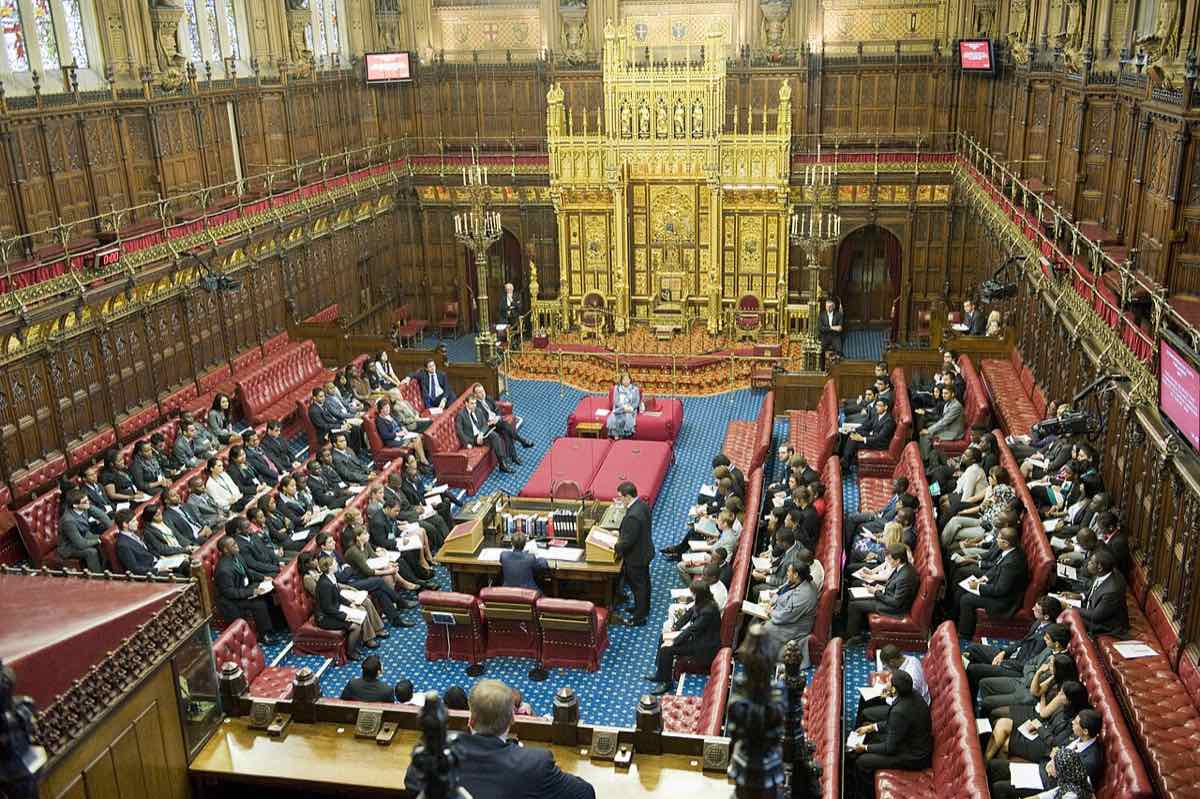
The House of Lords is famous for its red leather benches (in the Commons they are green). The golden throne at the far end is where the monarch sits each year to open Parliament.
UK Government, Open Government Licence v3, via Wikimedia Commons
So what does the House of Lords do?
It is normally more independent of the government than the Commons.
It can suggest changes to laws or propose new ones, which MPs then discuss.
It looks closely at laws passed by the Commons to make sure they will actually work.
It keeps an eye on the government to check that it is working in the public's best interest.
Some peers are experts in a particular field, and that knowledge helps when laws are being made and checked.
If the two Houses disagree, the Commons has the power to overrule the Lords, although this rarely happens.
Quiz
Since which year has the Prime Minister had the power to nominate life peers?
Life peers began in 1958. 1999 is when hereditary peers lost their automatic seats; 1928 is when men and women could both vote at 21; 1969 is when the voting age came down to 18. These four years are easy to mix up, and they often appear in the same question.
The Speaker: the referee of the Commons
When the Commons holds a debate, the person sitting in the middle and running things is the Speaker. The Speaker is the Commons' chief officer, and the role is an unusual one:
The Speaker is an MP too, still representing a constituency and dealing with local people's problems. But while in the job, the Speaker stays neutral and does not represent any party.
Other MPs choose the Speaker in a secret ballot (a vote where nobody sees how you voted).
The Speaker keeps order in debates and makes sure everyone follows the rules. That includes making sure the opposition gets a fair amount of time to debate topics it chooses.
At ceremonies, the Speaker represents Parliament.
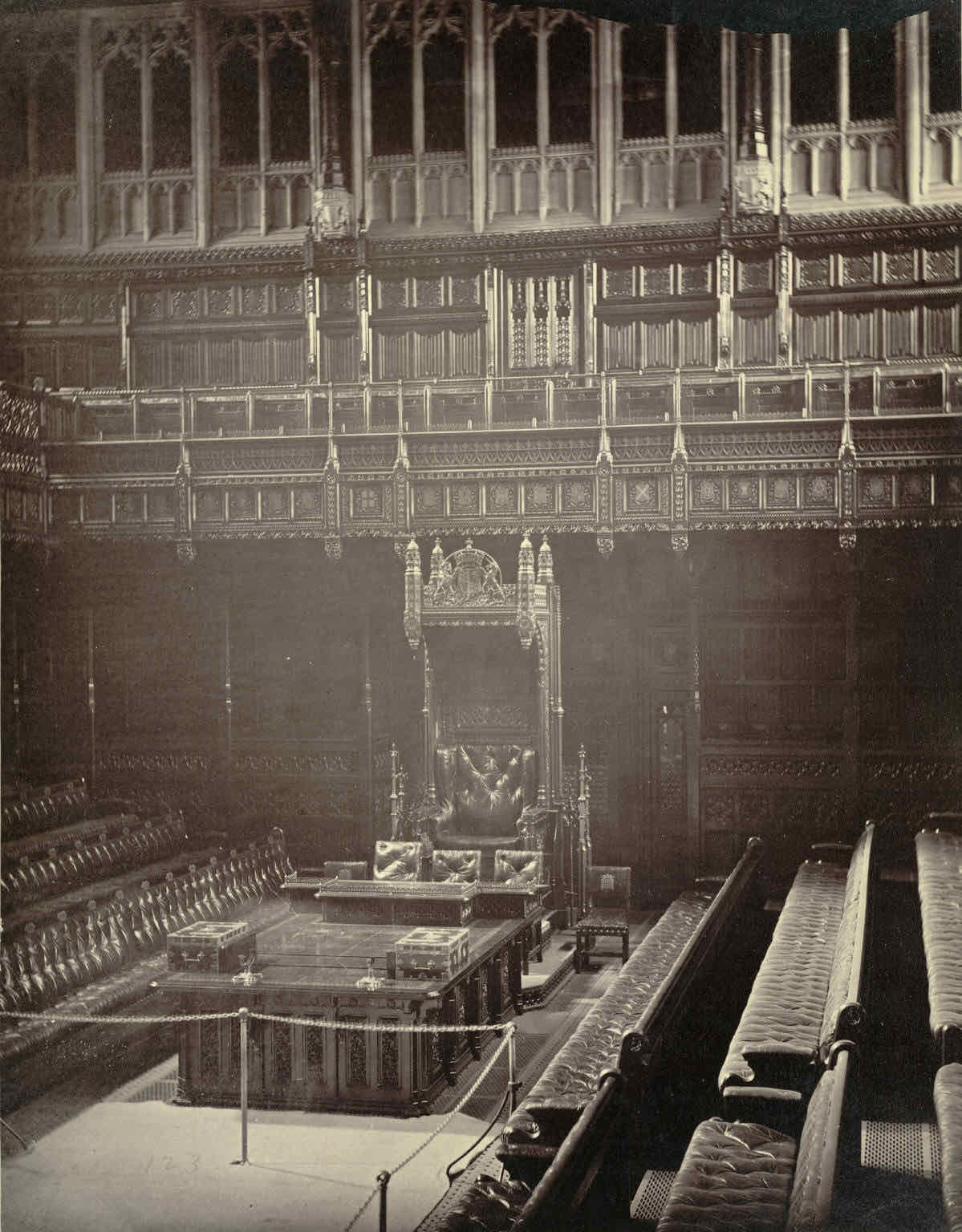
The Speaker's chair in the House of Commons, photographed around 1870–1885. The chair and the whole chamber were burnt out by German bombing in May 1941 and rebuilt after the war. When a new Speaker is chosen, two MPs "drag" them to this chair while they pretend not to want to go. The custom is said to recall the days when the Speaker carried the Commons' messages to the king, and between the Middle Ages and the Tudor period several Speakers really were executed.
Photographer unknown, A. D. White Architectural Photographs, Cornell University Library, public domain, via Wikimedia Commons
Quiz
Which of the following statements is correct?
MPs elect the Speaker by secret ballot, and the Speaker must stay neutral. It is the Prime Minister and other ministers, not the Speaker, who speak for the government in debates.
General elections, by-elections and "first past the post"
MPs are chosen at a General Election, held at least once every five years. When an MP dies or steps down, a separate election to replace them is held in that constituency. This is called a by-election.
MPs are elected using a system called first past the post. In each constituency, the candidate with the most votes wins, even without more than half of all the votes. The party that wins most constituencies, with a majority of seats, normally forms the government. If no party has a majority, two parties can work together and form a coalition.
The name comes from horse racing: the first horse to pass the winning post wins, however small its lead. In the same way, one vote more than anyone else is enough to win a seat.
Not every UK election works like this. The devolved parliaments and assemblies you'll meet later in this chapter are elected by forms of proportional representation, where each party's share of the seats roughly follows its share of all the votes.
Quiz
Is the statement below TRUE or FALSE?
When an MP dies or resigns, their seat stays empty until the next General Election.
False. If an MP dies or resigns, a by-election is held in that constituency, so local people can elect a new MP straight away. They do not have to wait for the next General Election.
Quiz
What is the name of the voting system used to elect MPs to the House of Commons?
General elections use first past the post: in each constituency, the candidate with the most votes wins. Proportional representation is used for the Scottish Parliament, the Welsh Assembly and the Northern Ireland Assembly.
Need your MP? Write, phone, or go to a "surgery"
Every elected representative has a duty to serve and represent the people who elected them. Here is how to get in touch with yours:
Look up the contact details of your representatives and their parties at a local library or on the UK Parliament website (parliament.uk). MPs, Assembly members and MSPs are also listed in BT's The Phone Book.
Contact them by letter or phone, either at their local constituency office or at their House of Commons office.
Many MPs hold regular surgeries in their area, where you can go and talk to them in person about anything that worries you. Surgery times are usually advertised in the local newspaper.
Quiz
Which TWO of the following are ways to contact your MP?
You can write to or phone your MP at their constituency office or their House of Commons office, and many MPs hold regular local surgeries where you can talk to them face to face. So post is not the only way. Prime Minister's Questions is a weekly session in the House of Commons where MPs, not members of the public, question the Prime Minister.
Devolution: Edinburgh, Cardiff and Belfast
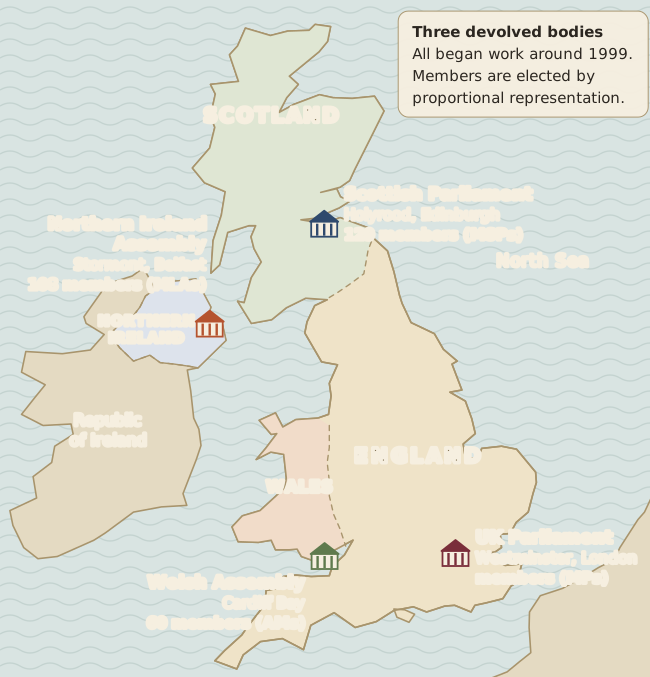
Since 1997, the central government has handed some of its powers to Wales, Scotland and Northern Ireland. This is called devolution, and the powers are devolved: people there get more say over the things that affect them directly. The Welsh Assembly and the Scottish Parliament have existed since 1999. Northern Ireland has the Northern Ireland Assembly, although it has been suspended several times.
So which decisions stay in London, and which are made locally?
UK government
Kept by the central UK government: defence, foreign affairs, immigration, taxation and social security (state benefits)
Devolved
Many other public services are run by the devolved governments, for example education
Each of the three devolved administrations also has its own civil service.
Where the four legislatures meet, and what their members are called. Test questions like to mix up MP, MSP, AM and MLA, so link each one to its place and you won't get them confused. The Northern Ireland Assembly has 108 MLAs.
Quiz
Which TWO areas of policy stay under the control of the UK government, and are not devolved?
Central government keeps five areas: defence, foreign affairs, immigration, taxation and social security. Education and health are both handled by the devolved bodies in Wales, Scotland and Northern Ireland.
Wales: the National Assembly in Cardiff
The Welsh government and the National Assembly for Wales are based in Cardiff, the Welsh capital. The Assembly has 60 members, called Assembly Members (AMs). Elections take place every four years and use a form of proportional representation. Members can speak in Welsh or English, and everything the Assembly publishes is in both languages.
The Assembly can pass laws for Wales in 21 areas, among them education and training, health and social services, economic development, and housing. Since 2011, it has been able to make laws in these areas without the agreement of the UK Parliament.
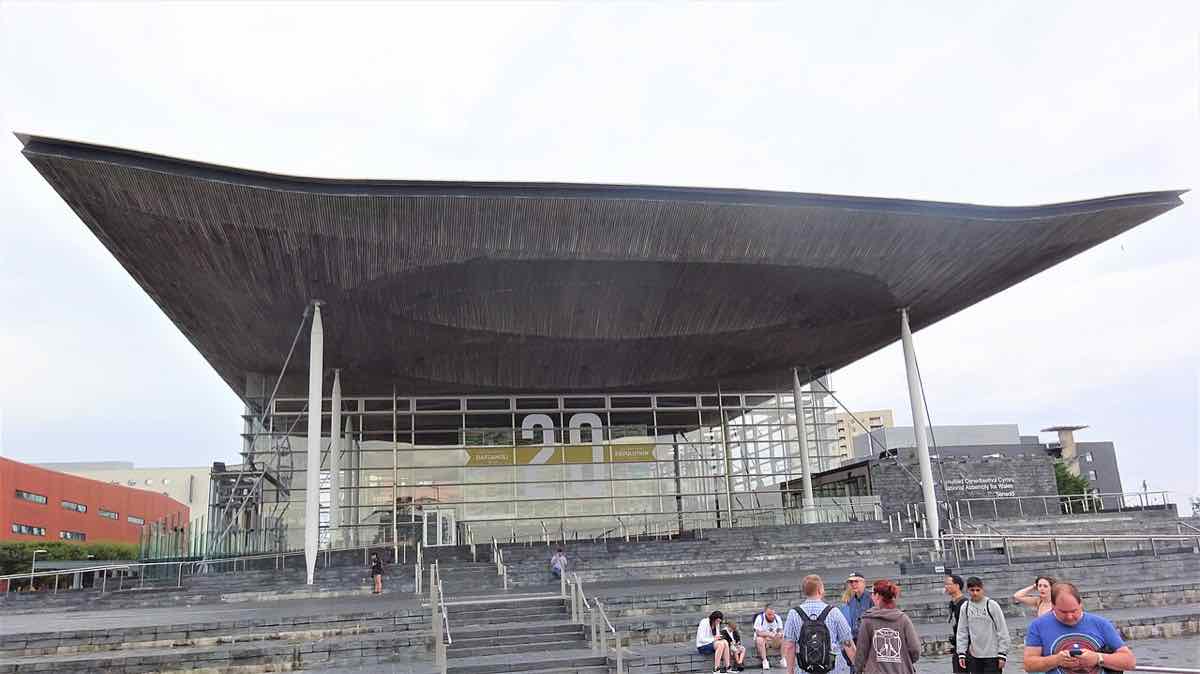
The Senedd building in Cardiff Bay opened in 2006. It was designed by the British architect Richard Rogers. All the glass is meant to stand for openness, and members of the public can walk freely into its public hall.
Photo: Rosser1954, CC BY-SA 4.0, via Wikimedia Commons
Scotland: the Scottish Parliament in Edinburgh
The Scottish Parliament was set up in 1999 and sits in Edinburgh, the capital of Scotland. It has 129 members, called MSPs (Members of the Scottish Parliament), who are elected by a form of proportional representation.
The Scottish Parliament has more power than the Welsh Assembly. It can make laws for Scotland on anything that is not specifically kept for the UK Parliament, such as civil and criminal law, health, education and planning, and it also has some extra powers to raise taxes.
The Parliament's own building at Holyrood wasn't finished until 2004, so for its first five years MSPs met in the Church of Scotland's General Assembly Hall in Edinburgh. The new building ended up costing far more than planned, which caused quite a row at the time.
Northern Ireland: the Assembly at Stormont
When Ireland was divided in 1922, Northern Ireland got its own Northern Ireland Parliament. After the conflict known as the Troubles broke out in 1969, that Parliament was abolished in 1972.
In 1998 the Belfast Agreement, also called the Good Friday Agreement, was signed. Soon afterwards the present Northern Ireland Assembly was created. Under a power-sharing arrangement, the jobs of the ministers in charge of government departments are shared out between the main parties. The Assembly has 108 members, called MLAs (Members of the Legislative Assembly), elected by proportional representation.
The Northern Ireland Assembly makes decisions on matters such as education, agriculture, the environment, health and social services.
The UK government has the power to suspend any of the devolved assemblies. It has done this to the Northern Ireland Assembly several times, when the leaders of the political parties there found it hard to work together.
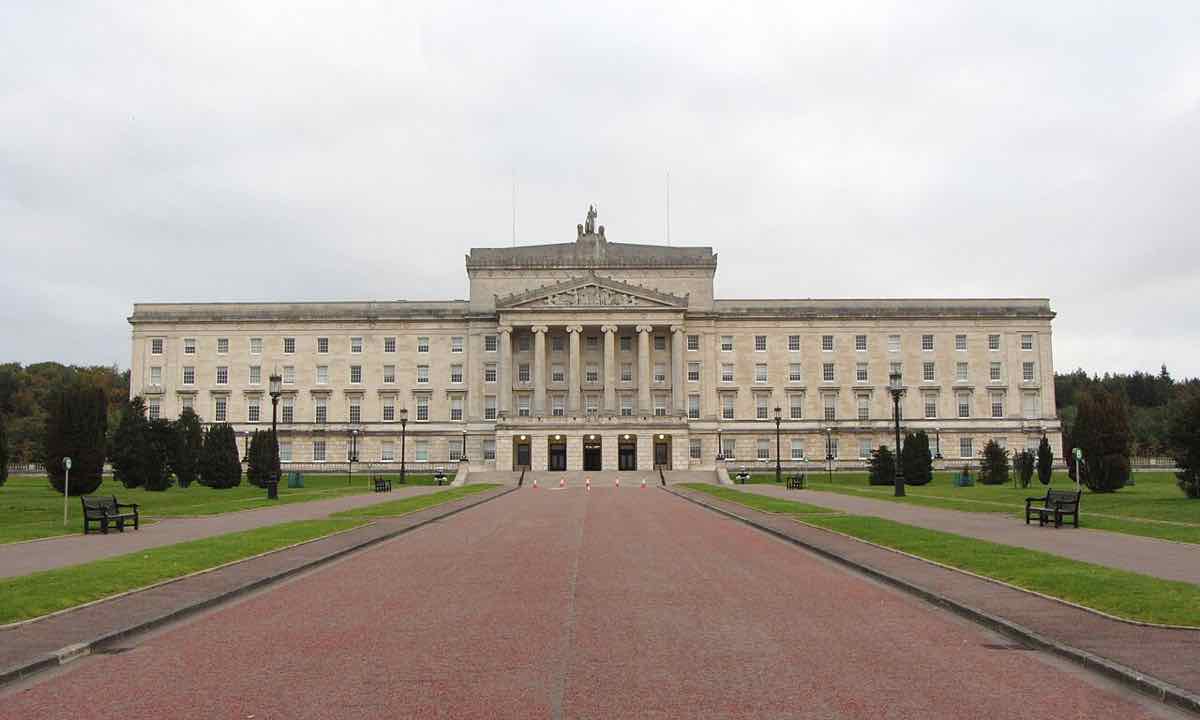
Parliament Buildings at Stormont, Belfast, opened in 1932. The Northern Ireland Assembly meets here.
Photo: Gareth James, CC BY-SA 2.0, via Wikimedia Commons
Quiz
Where do the elected members of the Northern Ireland Assembly meet?
The Northern Ireland Assembly meets at Stormont in Belfast. Holyrood is the Scottish Parliament in Edinburgh, the Senedd is the Welsh body in Cardiff, and Westminster is the UK Parliament in London.
The media and government: Parliament in the open
What happens in Parliament is shown on television and printed in an official record called Hansard. You can read the written record in large libraries and on the Parliament website.
Hansard was a real person. In the early 19th century, reports of the debates were printed by a printer named Thomas Curson Hansard. Parliament later took over the job itself, but his name has stuck to this day.
Most people learn about politics from newspapers (often called "the press"), television, radio and the internet.
The UK has a free press: the government does not control what newspapers write. Some newspaper owners and editors have strong political views and run campaigns to sway government policy and public opinion.
Television and radio are different: by law, they must give balanced coverage of the political parties and allow equal time for opposing views.
Quiz
Is the statement below TRUE or FALSE?
Parliamentary debates are written down and published in an official record called Hansard.
True. Parliament's proceedings are also shown on TV. Watch out for another trick question: newspapers are free from government control, but TV and radio must by law be balanced. Don't mix the two up.
Who can vote? Get on the electoral register first
The previous chapter told the story of how the right to vote was won step by step. Full democracy at the ballot box arrived in 1928, and in 1969 the voting age was lowered to 18. With only a few exceptions, all adult citizens, whether born in the UK or naturalised (people who became citizens later), can vote.
Who can vote in every kind of public election? There are three groups:
UK
Adult UK citizens
Commonwealth
Commonwealth citizens who are living in the UK
Irish
Citizens of Ireland who are living in the UK
The electoral register
To vote in a parliamentary or local election, your name must be on the electoral register (the official list of voters).
If you are eligible, contact the electoral registration office at your local council to register. It is usually at the council itself, though in Scotland it may be somewhere else.
If you don't know which council you belong to, the aboutmyvote website can find it from your postcode. You can also download registration forms there in English, Welsh and several other languages.
The register is updated every year in September or October. A form is sent to every household, and someone fills it in with everyone living there who is eligible to vote, then sends it back.
Northern Ireland does it differently, with individual registration: every eligible person fills in their own form. Once registered, you stay on the register as long as your details don't change.
By law, the local council must let anyone look at the register, but only under supervision. It is kept at the local electoral registration office (in England and Wales, the council offices), and you can also see it in some libraries and other public buildings.
Quiz
Which of the following statements is correct?
UK citizens, and Commonwealth and Irish citizens who live in the UK, can vote in every public election. Citizens of other EU countries are not on that list, and they cannot vote in General Elections.
Polling day: from poll card to ballot box
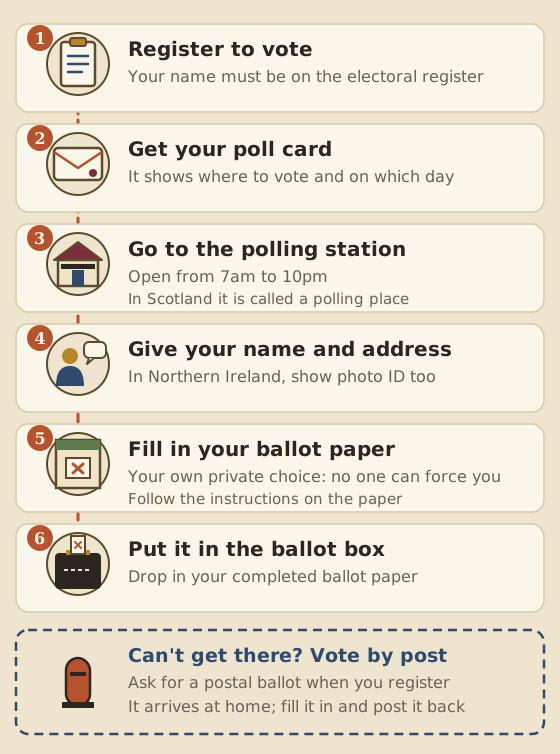
You vote at a polling station, which in Scotland is called a polling place. Before the election you will receive a poll card in the post. It tells you where your polling station is and the date of the election. On polling day, polling stations are open from 7am to 10pm.
Voting in six steps. If getting to a polling station is hard for you, you can choose to vote by post when you register.
When you arrive, polling station staff check your name and address. Voters in Northern Ireland also have to show photographic identification (photo ID).
You are given a ballot paper, which you fill in privately in a polling booth. Who you vote for is your decision alone: nobody is allowed to pressure you into choosing a certain candidate.
Fill it in by following the instructions on the paper, then put it in the ballot box.
If getting to the polling station would be hard for you, you can apply to vote by post, using a postal ballot. The ballot paper comes to your home before polling day; you complete it and send it back. You can ask for this when you register to vote.
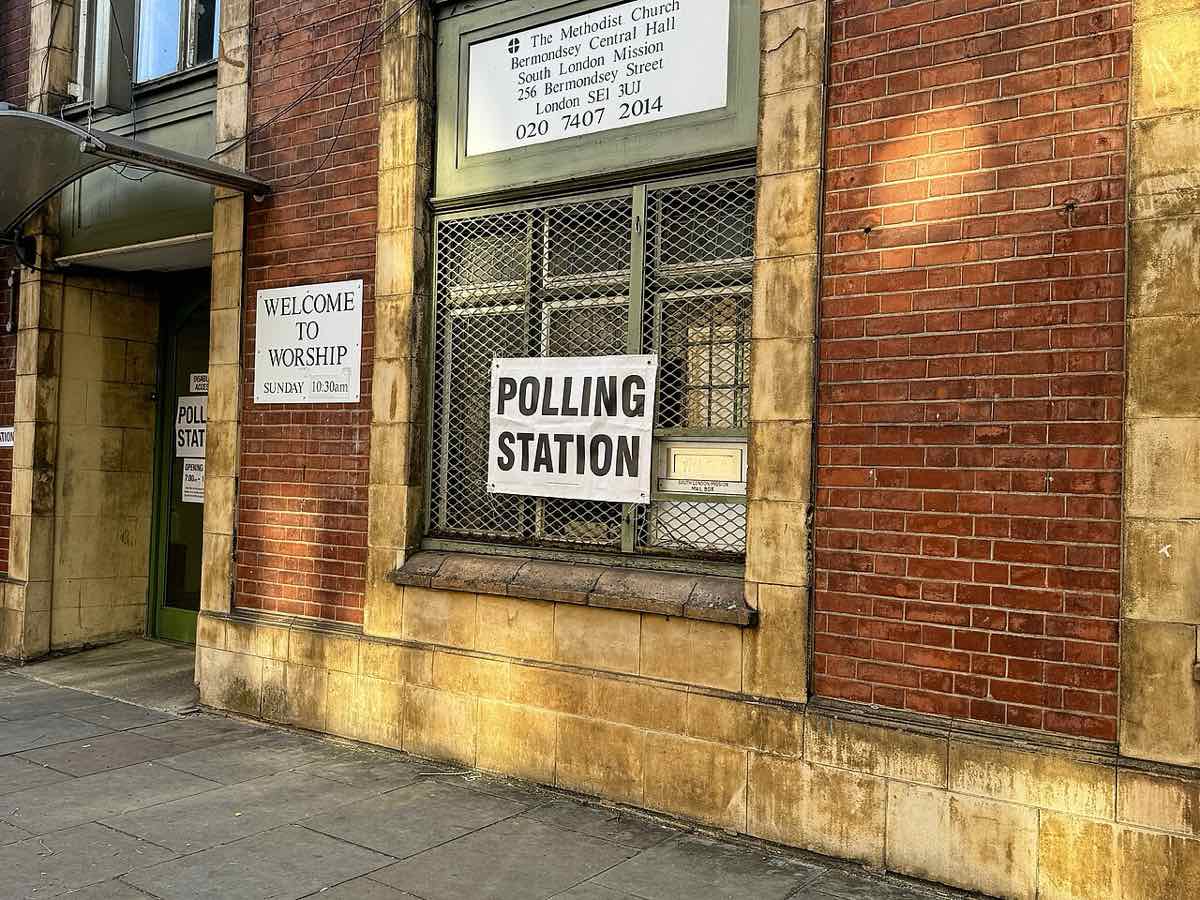
On general election day, the hall of a Methodist church in Bermondsey, London, became a polling station.
Photo: Bex Walton, CC BY 2.0, via Wikimedia Commons
Quiz
Before an election, what are you sent that tells you where your polling station is and when the vote takes place?
A poll card arrives before the election and tells you where to vote and on what date. You are given your ballot paper at the polling station itself (unless you have chosen a postal ballot). The electoral register is the list of people registered to vote, and the registration form is how you get onto it.
Quiz
On election day, between which hours is a polling station open?
From 7am to 10pm: 15 hours in all, so people who work can vote before or after their working day.
Standing for election yourself
You don't just have to vote: you can stand as a candidate too. If you are 18 or older and a citizen of the UK, the Irish Republic or a Commonwealth country, you can usually stand for public office. A few groups are excluded:
members of the armed forces
civil servants
people who have been found guilty of certain criminal offences
Also, members of the House of Lords cannot stand for election to the House of Commons, although they can stand for any other public office.
Quiz
Which TWO groups of people are generally not allowed to stand for public office?
Members of the armed forces, civil servants and people convicted of certain crimes cannot stand. Most Irish and Commonwealth citizens aged 18 or over can. Civil servants are excluded for the same reason the previous chapter gave: they must stay politically neutral.
Watching Parliament at work
Debates in Parliament are public, and anyone can go in and listen.
London: the UK Parliament
Members of the public can watch debates in the Palace of Westminster from the public galleries of the House of Commons and the House of Lords. It's free. You can ask your MP for tickets ahead of time by writing to them, or just join the queue at the public entrance on the day. For the Commons the wait can be an hour or two, or even longer; getting into the Lords is usually easier.
The three devolved bodies
Northern Ireland: MLAs sit at Stormont, in Belfast. To arrange a visit, contact the Assembly's Education Service, use the Assembly's website, or ask an MLA.
Scotland: MSPs sit in the Parliament building at Holyrood, Edinburgh. The visitor services team can give you information, book tickets and arrange tours.
Wales: AMs meet in the Senedd in Cardiff Bay. You can book a guided tour or a seat in the public gallery.
The UK and international organisations
The UK doesn't only elect representatives at home: it is also a member of many international organisations. The test often asks what each one does and how it differs from the others.
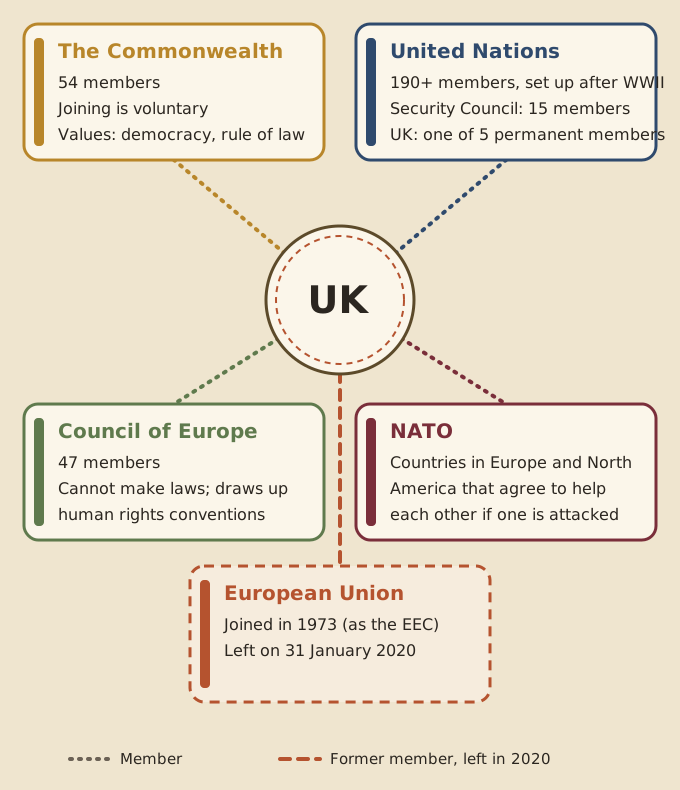
International organisations the UK belongs to. The dashed link marks the European Union, which the UK has left.
The Commonwealth
The Commonwealth is a group of countries that back one another and share the aims of democracy and development. Most of its members were once part of the British Empire, but a few countries that never were have joined too.
The British monarch is the ceremonial head of the Commonwealth.
It has 54 member states.
No country has to join: membership is voluntary. The Commonwealth can't force its members to do anything, but it can suspend a member.
Its core values are democracy, good government and the rule of law.
You don't need a British past to join. Mozambique, a former Portuguese colony, became the first member that had never been part of the British Empire when it joined in 1995. Rwanda followed in 2009.
The Council of Europe
The Council of Europe is often confused with the EU, but it is a separate organisation. It has 47 member countries, including the UK. Its job is to protect and promote human rights in its member countries. It has no power to make laws; instead it draws up conventions and charters. The best known is the European Convention on Human Rights, which the next chapter looks at in detail.
The United Nations
The UK is a member of the United Nations (UN), which has more than 190 member countries. It was created after the Second World War, with the aim of preventing war and promoting international peace and security. The UN Security Council has 15 members and recommends what should be done when there is an international crisis or a threat to peace. The UK is one of its five permanent members.
The UN General Assembly actually met for the first time in London, on 10 January 1946, at Methodist Central Hall in Westminster. The hall stands right opposite Westminster Abbey, a short walk from Parliament.
NATO
The UK is also a member of NATO (the North Atlantic Treaty Organization). NATO is made up of countries in Europe and North America that have agreed to help one another if any of them is attacked. NATO also works to keep the peace between its members.
Quiz
When was the United Nations set up?
The UN was created after the Second World War, with the aim of preventing war and promoting international peace and security. The international body set up after the First World War was a different one, the League of Nations. 1973 is when the UK joined the EEC, which has nothing to do with the UN.
Quiz
Which of the following statements is correct?
Joining the Commonwealth is voluntary. It has no power to force its members to do anything, but it can suspend them. The body that draws up conventions is the Council of Europe, and it cannot make laws either.
Quiz
Is the statement below TRUE or FALSE?
The UK is one of ten permanent members of the UN Security Council.
False. The Security Council has 15 members, but only 5 of them are permanent, and the UK is one of those 5. To remember: 15 members, 5 permanent.
Chapter summary
House of Commons
Elected, and the more important House; the PM and almost all the Cabinet are MPs. MPs represent everyone in their constituency, help make laws, check the government and debate national issues
House of Lords
Peers are not elected and have no constituency. Life peers since 1958; since 1999 hereditary peers elect a few of their number. Can suggest amendments and examine laws; the Commons can overrule it
Speaker
Runs Commons debates, is neutral, and is chosen by MPs in a secret ballot; protects the opposition's debating time
General Election
At least every five years; a by-election if an MP dies or resigns
First past the post
The candidate with most votes in each constituency wins; with no majority, parties can form a coalition
Surgeries
Times when you can meet your MP, advertised in the local paper; you can also write or phone to the constituency or Commons office
Devolution 1997 / 1999
Powers devolved from 1997; Welsh and Scottish bodies since 1999. Defence, foreign affairs, immigration, taxation and social security stay central
Wales: Cardiff, 60 AMs
Elected every four years by PR; Welsh or English; laws in 21 areas; since 2011 without the UK Parliament's agreement
Scotland: Edinburgh, 129 MSPs
Set up in 1999; laws on anything not reserved for the UK Parliament: civil and criminal law, health, education, planning, extra tax powers
NI: Stormont, 108 MLAs
Old Parliament 1922–1972; Assembly after the 1998 Agreement, with power-sharing; education, agriculture, environment, health, social services
Hansard
The official record of Parliament; newspapers are free of government control, but TV and radio must be balanced
Who can vote
Fully democratic from 1928; age 18 from 1969. UK citizens, and Commonwealth and Irish citizens living in the UK: all public elections
Electoral register
Updated every September or October, with a form sent to every household; individual registration in NI; can be inspected under supervision
Polling station
Poll card; open 7am to 10pm; photo ID in Northern Ireland; you can also vote by post
Standing for office
UK, Irish and Commonwealth citizens aged 18+; not the armed forces, civil servants or people with certain convictions; peers cannot stand for the Commons
Visiting Parliament
Free; write to your MP or queue; the Lords is easier to get into. Stormont, Holyrood, the Senedd
Commonwealth
54 members, voluntary, members can be suspended; democracy, good government, rule of law
Council of Europe
47 members; protects human rights; makes no laws, but drew up the European Convention on Human Rights
UN / NATO
UN: 190+ members, a 15-member Security Council with the UK as one of 5 permanent members. NATO: Europe and North America defend each other
 Speaking for everyone in the constituency
 Helping to make new laws
 Checking and commenting on the government
 Debating big national issues